Mold Remediation in Corona
24/7 mold remediation in Corona and surrounding areas. IICRC-certified, insurance billing accepted. Call (951) 667-9910.
You notice a musty smell behind the bathroom vanity, or a dark smear spreading along the drywall seam below a window that leaked last winter. By the time mold is visible, or you can smell it before you can see it, colonies have typically been growing for days to weeks, digesting the paper facing on drywall, the wood fiber in framing, the organic binders in insulation. Mold remediation is not cleaning. It is a controlled demolition and decontamination process designed to stop active growth, remove colonized material, and verify through air testing that the indoor environment is back to an acceptable baseline.
What mold remediation actually involves
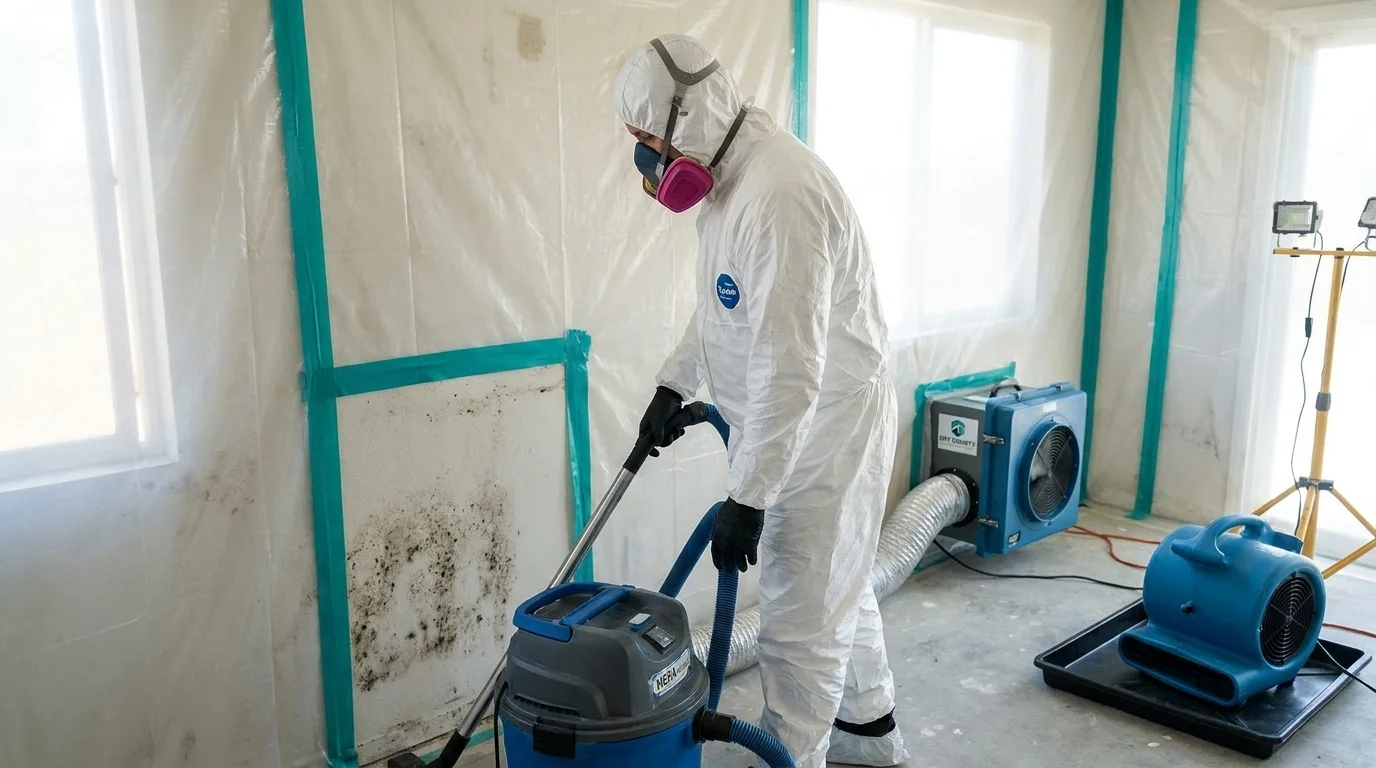
Remediation begins with understanding what you are dealing with. A musty smell in a closet and a black-stained subfloor beneath a failed dishwasher line are both mold problems, but they require very different scopes of work. The affected area has to be physically contained before any disturbing of growth begins, negative air pressure, poly sheeting, and sealed HVAC registers keep spores from migrating to unaffected rooms during the work. HEPA-filtered air scrubbers run continuously inside the containment zone, capturing airborne particles down to 0.3 microns.
Colonized materials, drywall, insulation, wood framing, flooring, are removed and double-bagged before transport out of containment. Surfaces that cannot be removed (structural lumber, concrete block) are wire-brushed, HEPA-vacuumed, and treated with an EPA-registered antimicrobial. The work is guided by the IICRC S520 Standard for Professional Mold Remediation, which defines when containment is required, what clearance looks like, and how post-remediation verification should be conducted. Dry County Restoration holds the IICRC AMRT (Applied Microbial Remediation Technician) certification, which means the crew working in your home has been trained to that standard.
Timeline depends heavily on scope. A single affected wall cavity might be cleared in one to two days. A crawl space with widespread joist colonization or a finished basement with concealed growth behind multiple walls can run a week or more, particularly when structural drying of residual moisture is needed before clearance testing can proceed.
Our process
-
Moisture investigation and scope definition. Before containment goes up, we trace the moisture source that fed the growth. Mold is a symptom. If the source, a slow pipe leak, condensation from an improperly insulated duct, a failed roof penetration, is not corrected, remediation is temporary. Thermal imaging and moisture meters map hidden saturation that visual inspection misses.
-
Use of containment to prevent the spread of mold spores. Poly barriers isolate the work zone. A HEPA-filtered negative air machine exhausts to the exterior, keeping the contained space at lower pressure than surrounding rooms so any disturbed spores move toward the machine, not toward your living space.
-
Controlled removal of colonized materials. Affected drywall, insulation, and other porous materials are removed in manageable sections, bagged inside containment, and transported out without cross-contaminating clean areas. Structural wood that can be retained is mechanically cleaned and treated.
-
HEPA vacuuming and antimicrobial treatment. All surfaces inside the remediated area, framing, subfloor, concrete, HVAC penetrations, are HEPA-vacuumed and wiped with an EPA-registered antimicrobial agent. This step is not optional and is not a substitute for physical removal of colonized material.
-
Post-remediation air sampling and clearance. An independent industrial hygienist or our certified technicians collect air samples inside and outside the former containment zone. Results are compared against outdoor baseline counts. Work is not complete, and containment does not come down, until the indoor spore counts are within acceptable range of outdoor levels.
What separates a good mold remediation response from a bad one
The most common failure in residential mold remediation is treating the visible surface and leaving the source moisture in place. Painting over mold or wiping it with bleach solution does not constitute remediation. Bleach does not penetrate porous materials, and without addressing the water intrusion, regrowth typically appears within weeks.
The second most common failure is skipping containment on smaller jobs. Disturbing even a few square feet of active mold growth without containment can spike airborne spore counts throughout the house. Occupants with respiratory sensitivities, asthma, or compromised immune systems are at particular risk during an improperly managed remediation.
Insurance adjusters and industrial hygienists look for a written scope of work tied to moisture readings, photo documentation of conditions before and after, evidence of proper containment, and a clearance test report from a qualified third party. A remediation that cannot be documented to that standard may not be reimbursable, and more importantly, it may not have actually worked.
OSHA-trained crews also recognize when a project involves materials that require additional precautions, older homes in Corona and the Inland Empire built before the late 1970s may have asbestos-containing materials in floor tile, joint compound, or popcorn ceilings that become a regulated concern the moment remediation disturbs them.
Seasonal and regional considerations
Corona sits at the edge of the Inland Empire where marine layer from the coast compresses against the foothills, creating humidity swings that are less predictable than the desert further east. Late spring and early fall can bring overnight relative humidity high enough to sustain mold growth in poorly ventilated spaces, attics with inadequate ridge venting, crawl spaces without vapor barriers, and interior wall cavities adjacent to north-facing exterior walls are the most common sites. Summer monsoon moisture pushing in from the southeast adds another window of elevated risk, particularly in older wood-frame construction that was not built with modern vapor management in mind.
Homes in the older neighborhoods of Corona, many built in the 1950s through 1970s, often have original single-pane windows and minimal wall insulation, which creates condensation surfaces in winter that can sustain mold growth inside wall assemblies without any plumbing failure at all.
Service area
Dry County Restoration is based in Corona and responds to mold remediation calls throughout the Inland Empire and surrounding communities, including Riverside, Norco, Eastvale, Chino Hills, Ontario, Rancho Cucamonga, and the foothill cities along the 91 and 15 corridors. Each city-specific service page links back here for the full process detail.
If you are smelling something that was not there before a recent leak, or you have found visible growth and are not sure how far it extends, call (951) 667-9910 to request an air quality assessment. We are available 24/7, and the sooner the moisture source and affected area are properly scoped, the more contained the remediation scope, and cost, tends to be.
Services We Handle
- Attic Mold Removal
- Basement Mold Removal
- Bathroom Mold Removal
- Black Mold
- Black Mold Removal
- Crawl Space Mold Removal
- Emergency Mold Removal
- Mold Cleaning
- Mold Damage
- Mold Damage Restoration
- Mold Mitigation
- Mold Remediation and Repairs
- Mold Remeditation
- Mold Removal Behind Walls
- Water Damage Mold Removal
Frequently Asked Questions
Does homeowners insurance cover mold remediation?
What is the difference between mold removal and mold remediation, and does it matter?
When does a mold job require full containment with negative air pressure, and when is it optional?
What does post-remediation clearance testing actually measure, and who conducts it?
How do I know if mold is growing inside my walls rather than just on the surface?
Looking for the best mold remediation company in Corona?
Dry County Restoration provides licensed and insured mold remediation in Corona, CA and the surrounding area, and has served local property owners since 2020. Customers rate us 5.0 out of 5 stars across 91 Google reviews. We answer calls 24/7 — call (951) 667-9910 for immediate help.
Need Mold Remediation now?
We respond 24/7 across Corona and surrounding CA cities.
Related Coverage
- Our Restoration Services
- Contact Dry County Restoration
- Mold Remediation in Anaheim
- Mold Remediation in Chino
- Mold Remediation in Chino Hills
- Mold Remediation in Fullerton
- Mold Remediation in Norco
- Mold Remediation in Ontario
- Mold Remediation in Riverside
- Mold Remediation in Santa Ana
- How To Choose a Restoration Company in Corona (Without Getting Burned)
- How To Test for Mold in Your Home (DIY Kits vs a Pro Inspection)
- 7 Signs You Have Hidden Mold (and What To Do Next)