Mold Remediation in Santa Ana
24/7 mold remediation in Santa Ana, CA. IICRC-certified, insurance billing accepted. Call (951) 667-9910.
Our IICRC-certified technicians are dispatched from our Corona, CA headquarters and are typically on-site in Santa Ana within about 2 hours of your call.
Santa Ana’s coastal-influenced climate, warm days, marine layer nights, and humidity that lingers in crawl spaces long after the morning fog burns off, creates conditions where mold can establish itself faster than most homeowners expect. A slow drip behind a stucco wall or a condensation problem in an older flat-roof addition doesn’t just stay wet; in this climate, it colonizes. Dry County Restoration’s IICRC AMRT-certified team handles mold remediation across Santa Ana, responding 24/7 from our Corona base.
Why Santa Ana Properties See Mold Issues
Santa Ana’s housing stock skews older. Much of the city’s residential fabric was built between the 1920s and the 1960s, when vapor barriers weren’t standard practice and wall cavities were left open to whatever moisture the soil and climate delivered. Stucco exteriors, nearly universal in this part of Orange County, are durable, but hairline cracks from settlement or seismic movement let moisture wick inward. Once water is behind stucco, it has nowhere to go except into the wood framing and insulation, where mold can begin colonizing within 24 to 48 hours of sustained saturation.
Santa Ana also sits in a basin where the water table is relatively shallow in lower-elevation neighborhoods. Slab foundations that were poured without modern moisture barriers can transmit ground moisture upward, keeping concrete and the flooring above it perpetually damp, a condition that shows up as musty odors long before visible growth appears. Older plumbing, including galvanized supply lines still present in some pre-1960s homes, corrodes from the inside out and can leak slowly inside walls for months before a homeowner notices.
Our Mold Remediation Process in Santa Ana
Every job starts with a thorough assessment, not a visual scan, but moisture mapping with calibrated meters and thermal imaging to find what’s wet behind surfaces that look dry. Mold remediation without finding the moisture source is a temporary fix; the growth returns.
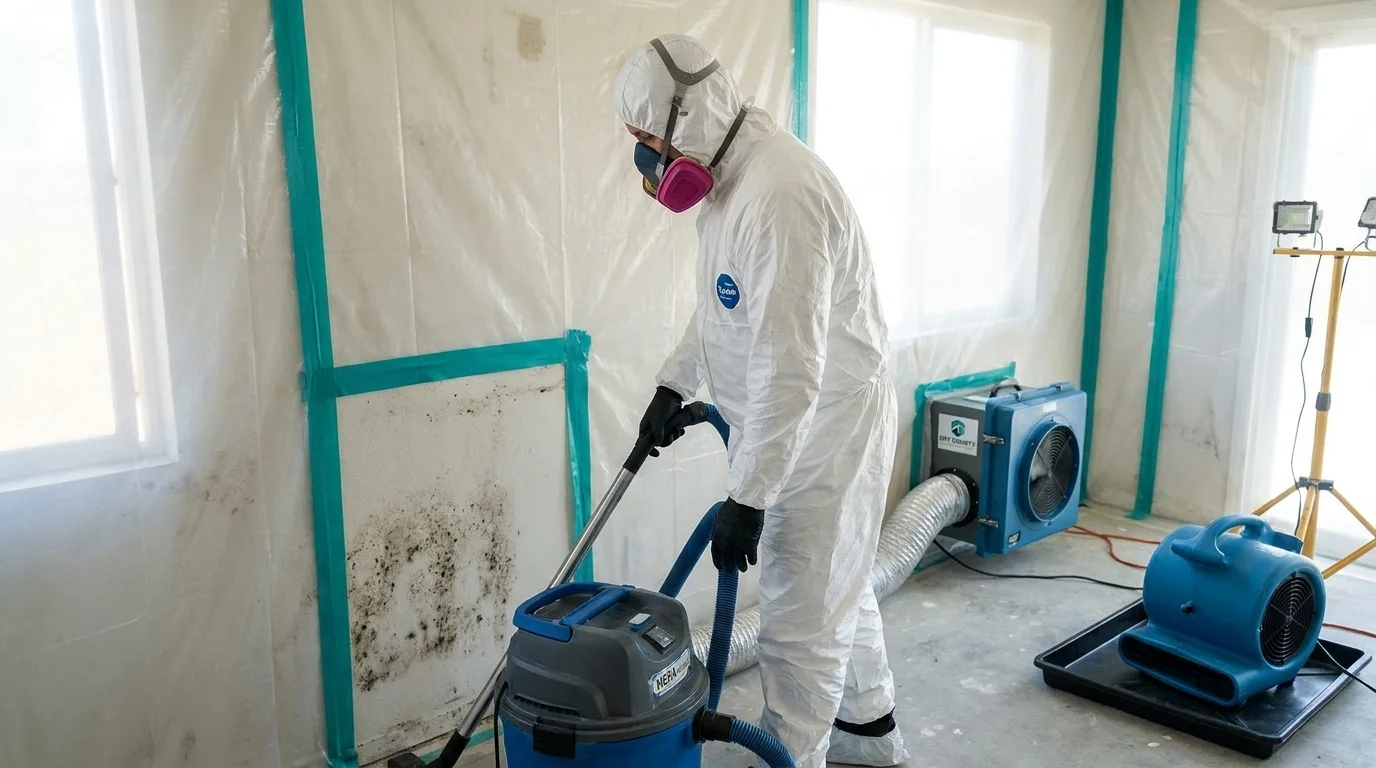
Once the scope is defined, we establish containment using negative air pressure and 6-mil poly barriers to prevent spores from migrating to unaffected rooms during removal. Affected porous materials, drywall, insulation, sections of subfloor, are removed, bagged, and disposed of per California’s handling requirements. Non-porous surfaces are HEPA-vacuumed and treated with EPA-registered antimicrobial agents.
Drying comes next. In Santa Ana’s climate, ambient humidity can slow the drying of structural cavities even in summer, so we use industrial dehumidifiers and air movers calibrated to the conditions on-site, not a one-size schedule. We monitor moisture readings daily until the structure meets the IICRC S520 standard before any rebuild begins.
Reaching Santa Ana from Corona
Dry County Restoration is based in Corona, and Santa Ana is a regular part of our service area. The most direct route runs west on the 91 Freeway to the 55 South, putting us into central Santa Ana in typical off-peak conditions. Because we operate 24/7, late-night and early-morning calls avoid the congestion that builds on the 91 corridor during commute hours, which matters when a homeowner discovers active water damage at 2 a.m. and mold is the next concern.
Santa Ana Insurance Coordination
Mold claims in California require careful documentation, and carriers vary significantly in what they’ll cover depending on whether the growth is tied to a sudden covered peril (a burst pipe) or long-term moisture intrusion. We photograph affected areas systematically, document moisture readings at each measurement point, and provide a written scope of work formatted for adjuster review. We work directly with most major carriers and can communicate with your adjuster on your behalf to reduce the back-and-forth that slows claim approvals.
If your property is governed by an HOA, common in Santa Ana’s condominium and townhome developments, we can provide the documentation those associations typically require before authorizing work on shared walls or common-area systems.
Local Note
In Santa Ana’s older neighborhoods, many homes were built with a construction method that used wood lath beneath plaster walls rather than modern drywall. Plaster-and-lath assemblies hold moisture differently: the surface can read dry on a pin meter while the lath behind it remains saturated and actively supporting mold growth. If your home was built before roughly 1960 and you’re seeing musty odors without obvious visible mold, that wall assembly is the first place we investigate, and it’s one reason we don’t stop at a surface reading.
If you’re dealing with a mold problem in Santa Ana, whether it’s a visible patch in a bathroom, a persistent smell after a plumbing leak, or a concern flagged during a home inspection, call Dry County Restoration at (951) 667-9910. We’ll assess the situation honestly, explain what we find, and give you a clear path forward.
Serving Santa Ana from our Corona headquarters — ★ 5.0 · 91 Google reviews
“Very professional Did. not require a call back Would highly recommend them to” — Gary, September 2026Read our reviews on Google →
Mold Remediation in Santa Ana: Service Coverage
Frequently Asked Questions
How fast can you arrive for mold remediation in Santa Ana?
How quickly can Dry County Restoration reach Santa Ana for a mold emergency?
Santa Ana has a lot of older stucco homes — does that affect how mold remediation is done?
Will my homeowner's insurance cover mold remediation in Santa Ana?
What's the timeline for mold remediation in a typical Santa Ana home?
Do Santa Ana HOAs require anything specific after mold remediation in a condo or townhome?
Mold Remediation response in Santa Ana
Most Santa Ana calls see a technician on-site within about 2 hours from our Corona headquarters.