24/7 Emergency Sewage Cleanup and Sanitization in Corona
24/7 emergency sewage cleanup and sanitization in Corona and surrounding areas. IICRC-certified, insurance billing accepted. Call (951) 667-9910.
Sewage backup in Corona? We answer 24/7. Call now and our crew heads out to contain the contamination and start the cleanup.
The smell hits before you see the water, that sharp, unmistakable odor of raw sewage backing up through a floor drain, a toilet, or a cleanout. Whether it’s a municipal sewer line surcharge during a heavy rain event, a blocked lateral, or a failing septic system, sewage in a living space is a Category 3 (“black water”) loss from the moment it appears. That classification matters because the contamination isn’t just unpleasant, it includes bacteria, viruses, and parasites that can colonize porous building materials within hours. Every minute the water sits, the scope of what has to be removed, not just dried, grows.
What sewage cleanup and sanitization actually involves
Sewage backup cleanup is not the same job as water damage restoration, even when the two look similar on the surface. With a clean water loss, the goal is to dry materials in place wherever possible. With raw sewage removal, the first question is always what can be saved and what has to come out, because porous materials (drywall, insulation, carpet, hardwood subfloor, even some cabinetry) that have absorbed Category 3 water cannot be dried and returned to service. They have to be removed, bagged, and disposed of according to local waste handling requirements.
The sanitization phase that follows extraction is equally specific. Industrial-grade EPA-registered disinfectants are applied to all affected hard surfaces, concrete slab, tile, framing lumber, floor joists, and allowed to dwell at the contact times specified on the product label. HEPA air scrubbers run continuously to capture aerosolized contaminants during demolition and cleaning. Moisture readings are taken at every session to confirm that the structural drying phase is actually working, because sewage losses frequently involve water that has wicked into wall cavities and under flooring where it is invisible at the surface.
Timeline: most residential sewage backup jobs move through extraction, demolition of unsalvageable materials, disinfection, and initial structural drying within 24 to 48 hours. Full structural drying typically requires three to five days depending on materials affected and ambient conditions. In Southern California’s dry climate, drying times can run shorter than national averages, but only when the right number of dehumidifiers are deployed for the square footage and material types involved.
Our process
-
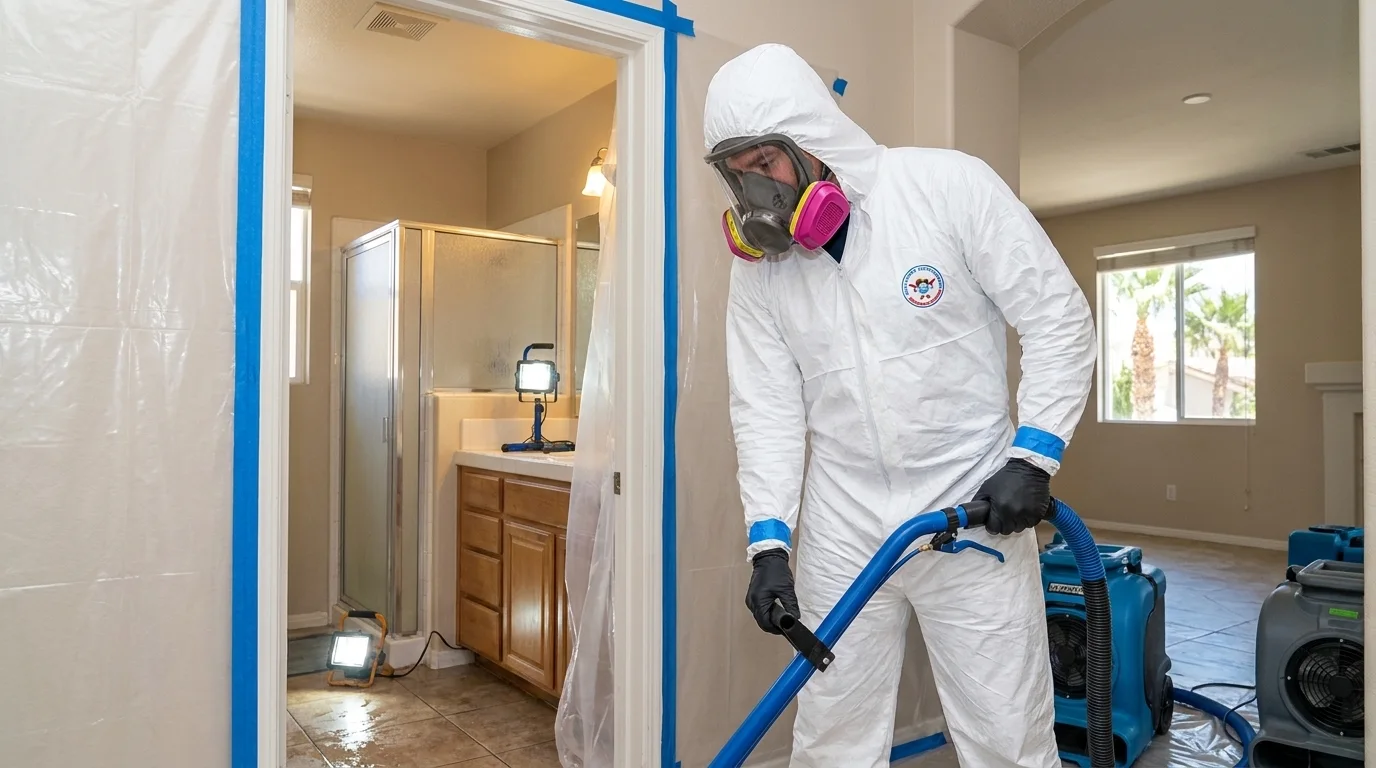
Containment and hazard assessment. Before any equipment enters the space, the affected area is assessed for scope and the contamination boundary is established. OSHA-trained technicians suit up in appropriate PPE, respirators, gloves, Tyvek, before any contact with affected materials. Containment barriers are staged where needed to prevent cross-contamination to unaffected areas of the home.
-
Extraction of standing sewage and contaminated water. Truck-mounted or portable extraction units remove standing water and sewage. This is not a shop-vac operation, high-capacity extractors are used to pull liquid from carpet, subfloor, and cracks in concrete before any drying equipment is placed.
-
Controlled demolition of unsalvageable materials. Drywall, insulation, carpet, pad, and any other porous material with confirmed Category 3 contact is removed to a clean margin. Materials are double-bagged and removed from the property in compliance with applicable waste handling requirements. Photographs and measurements are taken throughout for insurance documentation.
-
Disinfection and sanitization of structural surfaces. All remaining hard surfaces, concrete, tile, framing, joists, are treated with EPA-registered disinfectants at label-specified dwell times. A second application is standard on any surface with direct sewage contact. Air scrubbers with HEPA filtration run throughout this phase.
-
Structural drying and clearance verification. Low-grain refrigerant dehumidifiers are positioned per the IICRC S500 standard for the material types and square footage affected. Moisture readings are logged at each monitoring visit. Drying is not declared complete until readings return to established dry standards for the region, not just when the surface feels dry to the touch.
What separates a good sewage cleanup response from a bad one
The most common mistake in sewage backup cleanup is treating it like a Category 1 water loss. Technicians who extract the water, run fans, and call it done are leaving active biological contamination in the building. Drywall that absorbed black water and was dried in place, rather than removed, remains a contamination and odor source long after the equipment is gone.
A second common failure is incomplete extraction before drying equipment is placed. Water trapped under a floating floor or behind baseboard that isn’t pulled will not dry in any reasonable timeframe regardless of how much drying equipment is running.
Insurance adjusters on sewage losses look specifically for documentation of the contamination category, the moisture readings taken before and after, a clear demolition scope with photographs, and evidence that EPA-registered disinfectants were used at label dwell times, not just sprayed and wiped. An undocumented or under-documented sewage job frequently results in a disputed claim or a supplement fight months later when odor or mold returns.
Dry County Restoration is an IICRC Certified Firm with technicians holding IICRC Water Restoration Technician (WRT) and Applied Structural Drying (ASD) credentials, and the team is OSHA trained. License #1083555. Documentation is built into every step of the process, not added afterward.
Seasonal and regional considerations
In the Inland Empire and Corona specifically, the most common driver of municipal sewer backups is winter storm surges, heavy rainfall overwhelming aging clay-pipe laterals that run under homes built in the 1950s through 1980s. Those older pipes are prone to root intrusion and joint separation, and a storm event that pushes the city main to capacity can force sewage back up through the lowest fixture in the house, usually a floor drain or ground-floor toilet, within minutes of peak flow.
Septic system overflows follow a different seasonal pattern: they tend to surface in late winter and early spring when soil saturation reduces the drain field’s ability to percolate. Homes in the unincorporated areas east and south of Corona on older septic systems should have their systems inspected after any extended wet period.
Summer heat accelerates bacterial growth in any residual moisture left after a sewage event, which is why same-day extraction matters more in the Inland Empire’s climate than it might in a cooler region.
Service area
Dry County Restoration is based in Corona, CA and responds to sewage backup cleanup calls throughout the Inland Empire and surrounding communities, including Riverside, Norco, Eastvale, Chino, Ontario, Rancho Cucamonga, Yorba Linda, and Anaheim Hills. Each of those cities has its own combination of housing stock, sewer infrastructure age, and soil conditions that affect how a sewage loss behaves. The city-specific pages linked from this one go deeper on what homeowners in each area typically encounter.
If you’re standing in a room with sewage on the floor, call (951) 667-9910 now, Dry County Restoration answers 24/7. The longer black water sits in contact with your floors, walls, and framing, the more of your home has to come out rather than be dried and saved. Early extraction is the single biggest factor in keeping a sewage backup from becoming a full gut-and-rebuild.
Services We Handle
- Basement Sewage Cleanup
- Category 3 Water Cleanup
- Sewage Backup Cleanup
- Sewage Cleanup & Remediation
- Sewer Leak
- Toilet Overflow Cleanup
- Water Damage Sewage Cleanup
Frequently Asked Questions
Does homeowners insurance cover sewage cleanup and sanitization?
What is Category 3 water, and why does it change what has to happen during cleanup?
What should I do — and not do — while waiting for the crew to arrive after a sewage backup?
How do technicians know when a sewage-affected area is actually dry and safe — not just dry at the surface?
Can the sewage odor come back after cleanup, and what causes that?
Looking for the best sewage cleanup and sanitization company in Corona?
Dry County Restoration provides licensed and insured sewage cleanup and sanitization in Corona, CA and the surrounding area, and has served local property owners since 2020. Customers rate us 5.0 out of 5 stars across 91 Google reviews. We answer calls 24/7 — call (951) 667-9910 for immediate help.
Need Sewage Cleanup and Sanitization now?
We respond 24/7 across Corona and surrounding CA cities.
Related Coverage
- Our Restoration Services
- Contact Dry County Restoration
- 24/7 Emergency Sewage Cleanup and Sanitization in Anaheim
- 24/7 Emergency Sewage Cleanup and Sanitization in Chino
- 24/7 Emergency Sewage Cleanup and Sanitization in Chino Hills
- 24/7 Emergency Sewage Cleanup and Sanitization in Fullerton
- 24/7 Emergency Sewage Cleanup and Sanitization in Norco
- 24/7 Emergency Sewage Cleanup and Sanitization in Ontario
- 24/7 Emergency Sewage Cleanup and Sanitization in Riverside
- 24/7 Emergency Sewage Cleanup and Sanitization in Santa Ana