24/7 Emergency Fire Damage Restoration in Corona
24/7 emergency fire damage restoration in Corona and surrounding areas. IICRC-certified, insurance billing accepted. Call (951) 667-9910.
Fire damage emergency in Corona? We answer 24/7. Call now and our crew heads out to secure the property and start the recovery.
Smoke doesn’t stop at the burn line. After a house fire, soot particles travel through HVAC ducts, settle into closets two rooms away, and embed in porous surfaces, drywall, wood framing, upholstered furniture, within hours of the flames being extinguished. The visible char is only part of what needs to be addressed. The invisible residue, the acidic soot chemistry eating at metal fixtures, and the odor compounds baked into structural cavities are what make fire damage restoration a fundamentally different discipline from general cleanup.
What fire damage restoration actually involves
Fire leaves behind at least three distinct damage categories that have to be worked simultaneously: structural damage from heat and flames, surface contamination from soot and ash, and pervasive odor from combustion byproducts. Each requires different chemistry, different equipment, and a different sequence.
Soot itself isn’t uniform. Protein soot, from burning food, grease, or organic material, is nearly invisible, smears aggressively, and carries a sharp, acrid smell that penetrates paint and caulk. Synthetic soot from burning plastics, foam insulation, or synthetic carpet is oily, dark, and clings to cool surfaces like exterior walls and window frames. Wet soot from a fire suppressed with water is the heaviest and most corrosive. Identifying which type (or combination) is present determines which cleaning agents, dry-cleaning sponges, or chemical sponges are appropriate, and using the wrong one can permanently set the stain.
Beyond surface cleaning, structural cavities, wall bays, attic spaces, subfloor voids, trap smoke odor in ways that no surface wipe-down can reach. Thermal fogging and ozone treatment are used to penetrate those spaces and neutralize odor compounds at the molecular level, not just mask them. Contents pack-out, carefully inventorying, removing, and off-site cleaning salvageable belongings, protects items from secondary damage during the restoration work and gives the cleaning team unobstructed access to walls and floors.
Timeline depends heavily on the scope of the burn, but most residential fire losses involve at least one to two weeks of active restoration before reconstruction can begin.
Our process
-
Emergency board-up and site security. Before any cleaning begins, open windows, compromised walls, and damaged roof sections are secured. This protects the structure from weather intrusion and prevents secondary losses from theft or vandalism, both of which insurance adjusters document when they affect the claim.
-
Soot characterization and scope documentation. Every affected surface is assessed for soot type and penetration depth. Photographs, moisture readings, and air quality notes are compiled into a written scope that drives both the restoration plan and the insurance claim. This step is what separates a defensible claim from a disputed one.
-
Contents pack-out and inventory. Salvageable items are catalogued, packed, and transported to a controlled cleaning environment. This includes clothing, furniture, electronics, and personal documents. A detailed inventory is provided for insurance purposes.
-
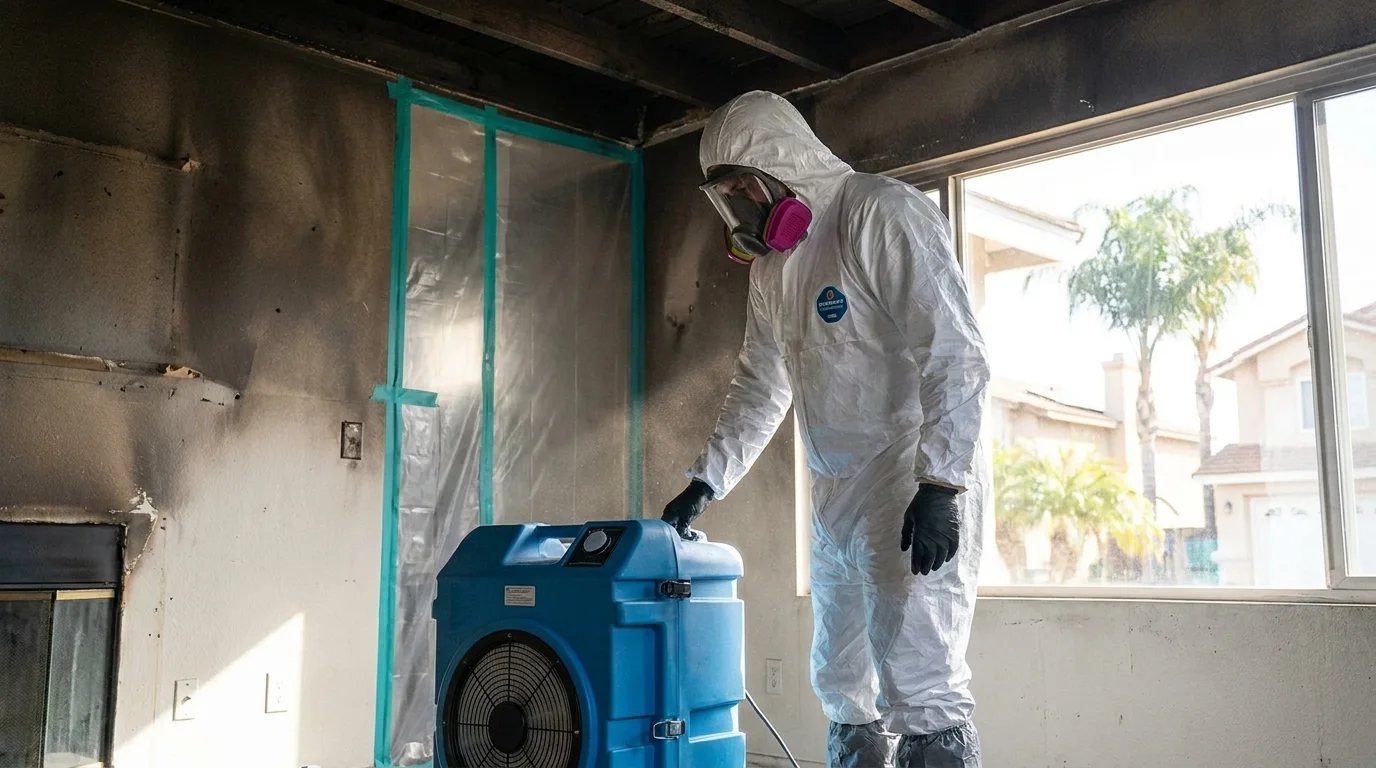
Structural cleaning and deodorization. Affected surfaces are cleaned using the appropriate method for the soot type present, dry-cleaning sponges for loose ash, chemical sponges for protein residue, alkaline cleaners for synthetic soot. HEPA vacuuming removes loose particulate before any wet cleaning begins. Thermal fogging or ozone treatment is then applied to penetrate wall cavities, ductwork, and framing where surface cleaning cannot reach. HVAC systems are inspected and cleaned separately to prevent redistributing contamination.
-
Clearance assessment and handoff to reconstruction. Once cleaning and deodorization are complete, affected areas are assessed to confirm residue and odor levels are within acceptable limits before any new drywall, paint, or flooring goes in. Sealing smoke-stained framing with an appropriate shellac-based or pigmented primer is a required step, not optional, before finish materials are applied. Our IICRC-certified team coordinates directly with the reconstruction phase so nothing gets buried behind new materials prematurely.
What separates a good fire damage response from a bad one
The most common failure in fire cleanup is treating it like a cleaning job rather than a restoration job. Crews that wipe visible soot, spray a deodorizer, and call it complete leave behind acid residue that continues corroding metal hardware, etching glass, and degrading paint long after the job is closed. Tarnishing on copper plumbing, pitting on chrome fixtures, and yellowing on ceilings months after a fire are almost always the result of incomplete soot removal in the first pass.
A second common failure is skipping the HVAC system. Smoke travels through return air pathways during and after a fire. If the duct system isn’t cleaned and the filter bank isn’t replaced, the HVAC redistributes fine particulate every time it cycles, recontaminating surfaces that were already cleaned.
Insurance adjusters look for a documented scope with line-item detail: which surfaces were cleaned, what method was used, what equipment was deployed, and what the pre- and post-treatment conditions were. A vague invoice without supporting documentation is the fastest path to a reduced or disputed claim. Dry County Restoration’s OSHA-trained team produces the kind of structured documentation that holds up through the full claims process.
Seasonal and regional considerations
California’s fire season extends well into fall, and the Santa Ana winds that push through the Inland Empire can drive embers and smoke into structures that weren’t directly in a fire’s path. Homes in Corona and the surrounding Riverside County foothills, particularly those near wildland-urban interface areas, face a distinct risk profile: exterior soot and ash deposition from nearby brush fires can infiltrate HVAC systems and attic spaces even when the structure itself is undamaged. This type of loss is frequently underestimated because there’s no visible char, but the smoke chemistry is identical and requires the same systematic cleaning response.
Older housing stock in established Corona neighborhoods, much of it built in the 1970s through 1990s, often has original ductwork and attic insulation that absorbs smoke more readily than modern construction and is harder to clean without full replacement.
Service area
Dry County Restoration is based in Corona and serves fire damage restoration calls throughout Riverside County and the surrounding region, including Norco, Eastvale, Chino Hills, Riverside, Moreno Valley, and the communities along the 91 and 15 corridors. Each city-specific service page covers local considerations in more detail.
If you’re looking at smoke-stained walls and the smell still hasn’t left the house, that’s the signal to act. Call Dry County Restoration at (951) 667-9910, available 24/7, to begin smoke and soot removal before secondary damage compounds the loss.
Services We Handle
- Fire & Smoke Restoration
- Fire and Smoke Damage Cleanup
- Fire Damage Cleanup
- Fire Damage Cleanup Repair
Frequently Asked Questions
What's the difference between protein soot and synthetic soot, and why does it change how cleanup works?
Does homeowners insurance cover fire damage restoration?
How long does fire and smoke restoration typically take before reconstruction can begin?
Why does the smell come back weeks after the fire was cleaned up?
What should I do — and not do — while waiting for the restoration crew to arrive after a fire?
Looking for the best fire damage restoration company in Corona?
Dry County Restoration provides licensed and insured fire damage restoration in Corona, CA and the surrounding area, and has served local property owners since 2020. Customers rate us 5.0 out of 5 stars across 91 Google reviews. We answer calls 24/7 — call (951) 667-9910 for immediate help.
Need Fire Damage Restoration now?
We respond 24/7 across Corona and surrounding CA cities.
Related Coverage
- Our Restoration Services
- Contact Dry County Restoration
- 24/7 Emergency Fire Damage Restoration in Anaheim
- 24/7 Emergency Fire Damage Restoration in Chino
- 24/7 Emergency Fire Damage Restoration in Chino Hills
- 24/7 Emergency Fire Damage Restoration in Fullerton
- 24/7 Emergency Fire Damage Restoration in Norco
- 24/7 Emergency Fire Damage Restoration in Ontario
- 24/7 Emergency Fire Damage Restoration in Riverside
- 24/7 Emergency Fire Damage Restoration in Santa Ana
- How To Choose a Restoration Company in Corona (Without Getting Burned)
- The Fire Damage Restoration Process, Explained