
Water Leak Detection in Santa Ana
24/7 water leak detection in Santa Ana, CA. IICRC-certified, insurance billing accepted. Call (951) 667-9910.
Our IICRC-certified technicians are dispatched from our Corona, CA headquarters and are typically on-site in Santa Ana within about 2 hours of your call.
Noticed a spike in your water bill or a damp spot that won’t explain itself? Santa Ana’s dry, low-rainfall climate means a hidden leak rarely announces itself the way it might in a wetter region. There’s no storm runoff to blame, no obvious puddle from the sky. If your water bill is climbing or a section of flooring feels warm or soft underfoot, that’s often the only early warning a slab leak or wall leak gives before the damage spreads. We answer 24/7 and can get a technician scheduled to track down the source before it undermines flooring, foundation, or drywall.
Why Santa Ana Properties See Leak Detection Issues
A large share of homes in Santa Ana were built during the postwar tract boom, with copper plumbing routed through concrete slab foundations, a standard method for that era across Orange County. Copper has a long service life, but after several decades it develops pinhole leaks from pitting corrosion, and because the pipe is embedded in or under the slab, the first sign is usually a hot spot on the floor, a hissing sound near a wall, or a water meter that keeps spinning even with every fixture off. The region’s expansive clay soils also shift seasonally, and that movement puts stress on rigid pipe joints that were never designed to flex. Add in the dry climate, where there’s little ambient moisture to make a leak obvious, and problems that would show up fast elsewhere can run for weeks here before anyone notices.
Our Water Leak Detection Process in Santa Ana
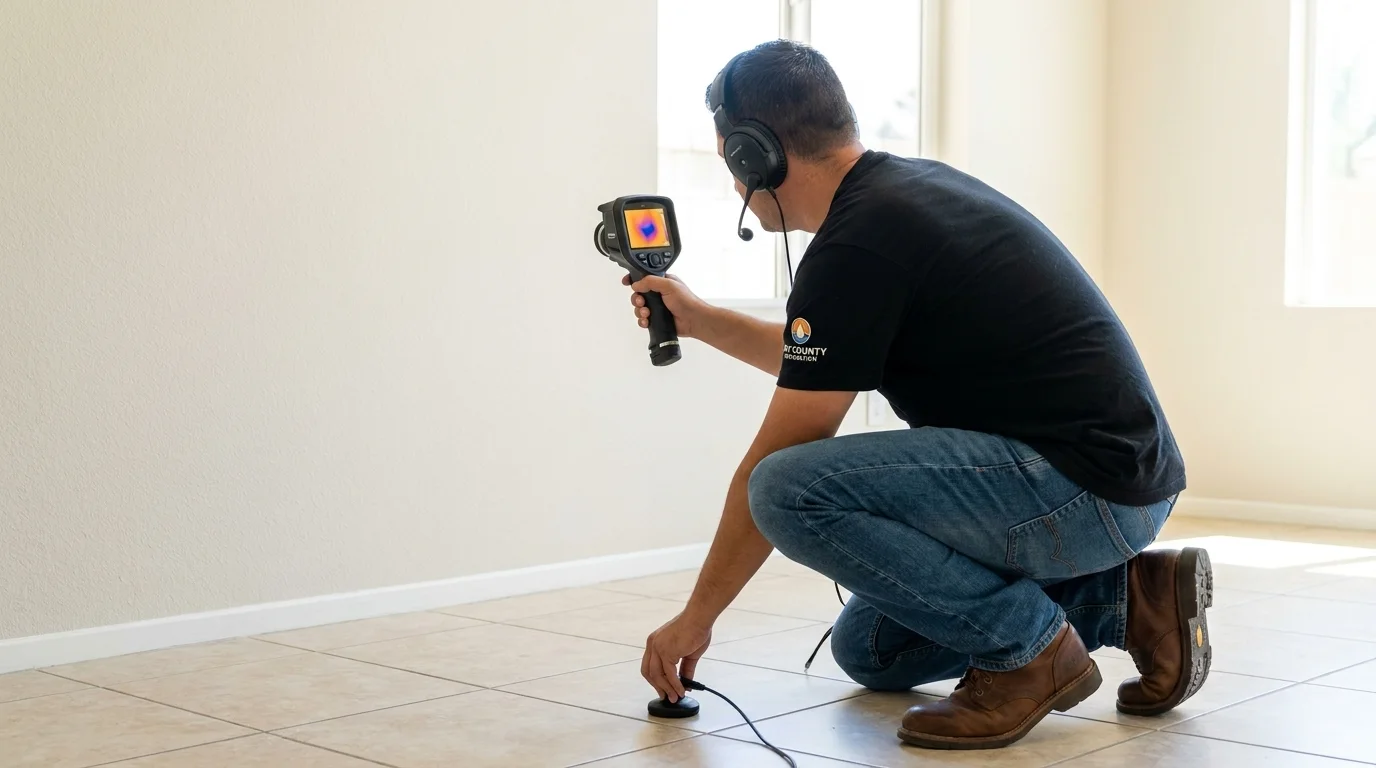
We start by ruling out the obvious, checking irrigation lines, water heater connections, and visible plumbing before assuming a slab or in-wall leak. From there we use acoustic listening equipment to pick up the sound of pressurized water escaping through a pipe, which carries differently through slab concrete than through open-frame walls. Thermal imaging helps confirm a suspected location by reading temperature differences at the surface, since an active leak under a slab often reads several degrees warmer or cooler than the surrounding floor. Where needed, we pair that with moisture meters to map how far water has traveled, because a leak’s source point and its visible damage are frequently several feet apart once water has tracked along a slab or stud bay. The goal is always to pinpoint the leak with minimal exploratory demolition, since every unnecessary cut adds to the repair bill.
Equipment & Methods We Use for Leak Detection
Slab leaks and in-wall leaks call for different tools, and we bring both. Acoustic correlators help isolate a leak’s position along a pipe run by comparing sound arrival times at two points, which works well on the rigid copper and older galvanized lines still common in Santa Ana’s established neighborhoods. For wall cavities, a combination of moisture mapping and borescope inspection lets us look inside a wall through a small access point rather than opening an entire section of drywall. When a slab leak is suspected, we also check static water pressure against the meter to confirm there’s an active leak before any demolition starts, since a false positive means cutting into a floor for nothing.
Santa Ana Insurance & HOA Coordination
Many Santa Ana condos and attached homes fall under an HOA, and most associations require advance notice before any flooring or slab work begins, along with documentation of the cause before approving repairs on shared plumbing lines. We photograph and document every stage of the leak detection process, which gives homeowners a clear record to submit to their HOA board or insurance adjuster. Sudden and accidental water damage is typically covered, but the pattern of a slow, long-term leak can be scrutinized more closely, so having a dated detection report matters for how a claim is handled.
Local note
One detail that catches a lot of Santa Ana homeowners off guard: because the climate here is so dry, a slab leak doesn’t always produce visible staining or odor the way it would in a humid region. By the time a homeowner notices a warm floor or a cracked tile, the leak has often been active for a while. We’ve learned to treat a sudden, unexplained jump in the water bill as seriously as any visible sign, since in this climate it’s frequently the first real clue.
If something about your water usage or flooring in Santa Ana doesn’t add up, don’t wait for a more obvious sign of damage. Call Dry County Restoration at (951) 667-9910 for water leak detection built around how plumbing actually behaves in Santa Ana’s slab-on-grade homes.
Serving Santa Ana from our Corona headquarters — ★ 5.0 · 91 Google reviews
“Very professional Did. not require a call back Would highly recommend them to” — Gary, September 2026Read our reviews on Google →
Water Leak Detection in Santa Ana: Service Coverage
Frequently Asked Questions
How fast can you arrive for water leak detection in Santa Ana?
How do I know if I have a slab leak versus a surface plumbing issue in my Santa Ana home?
Why do Santa Ana homes seem prone to slab leaks specifically?
Does my Santa Ana HOA need to approve leak detection or repair work?
What equipment do you use to find a leak without tearing up my floor?
Will my insurance cover a hidden water leak found in my Santa Ana home?
Water Leak Detection response in Santa Ana
Most Santa Ana calls see a technician on-site within about 2 hours from our Corona headquarters.