For water damage restoration in Corona, CA, call Dry County Restoration at (951) 667-9910. The company is an IICRC Certified Firm that answers 24/7 and is licensed and insured (CSLB #1083555), so a crew can start documenting and drying your property the same day you call.
But “who to call” depends on what’s actually happening in your house right now. A restoration crew, a plumber, and the fire department all solve different parts of a water emergency, and calling the wrong one first can cost you hours while damage spreads.
Who do you call first: a restoration company, a plumber, or 911?
Call a water damage restoration company first if the source is already stopped (or you can stop it yourself) and you have standing water, soaked drywall, or wet flooring to deal with. That’s the drying and damage-mitigation work, and it’s the clock-sensitive part: the IICRC S500 standard recognizes that mold can start colonizing damp drywall within 24 to 48 hours.
Call a plumber first (or in addition) if water is still actively flowing from a pipe, fixture, or water heater and you can’t shut it off at the main. Many Corona homes, especially tract houses built on expansive clay soil through the 1980s and 1990s, develop slab leaks that a homeowner has no way to isolate without a plumber locating the break.
Call 911 or your utility company first, before anyone else, if there’s standing water near an electrical panel, visible sparking, or a gas smell. No drying job is worth a shock or a gas hazard. Once the scene is safe, that’s when the restoration call happens.
If you’re not sure which bucket you’re in, the first 24 hours after water damage walks through the decision in more detail, including what to shut off and what to leave alone.
What happens when you call a water damage restoration company in Corona?
The first call is a short intake: your address, what happened (burst pipe, water heater failure, roof leak, sewage backup), and whether the water is still moving. From there, a technician is dispatched to assess the loss in person, not just quote a number over the phone.
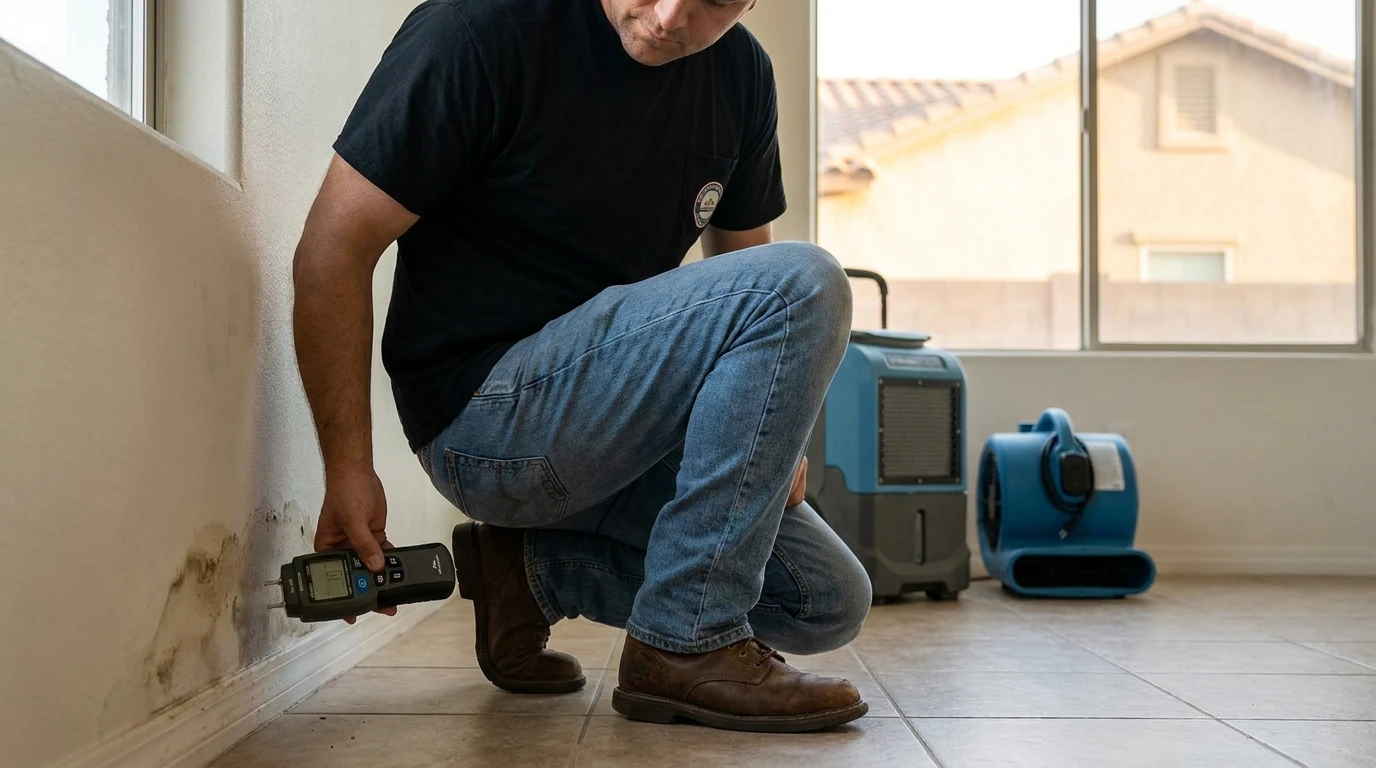
On arrival, the crew checks the source is fully stopped, then uses a moisture meter and often a thermal camera to map how far the water traveled under floors and inside walls, not just what’s visible. That map becomes the basis of a written scope, which matters later if you’re filing a claim: insurers want documentation, not estimates from memory.
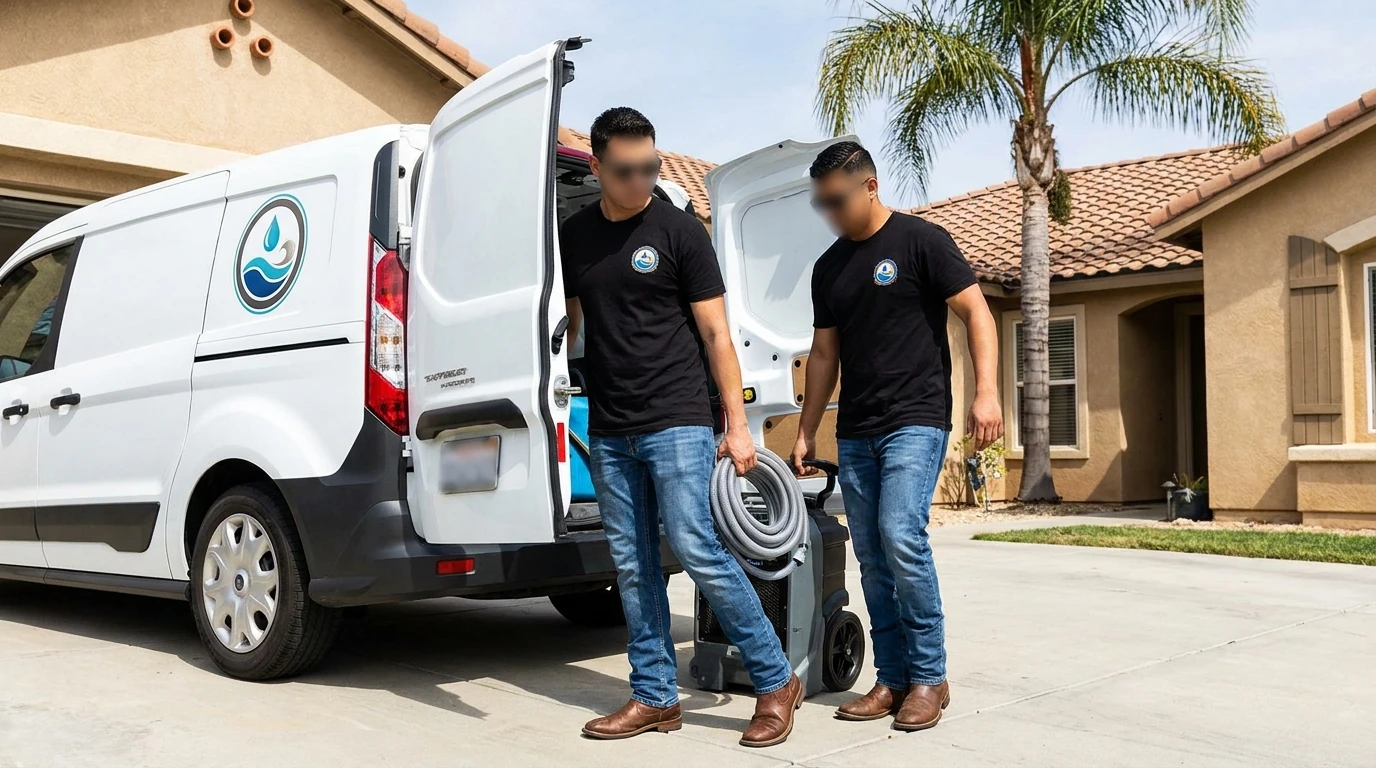
Extraction comes next: truck-mounted or portable extractors pull standing water, followed by air movers and low-grain-refrigerant (LGR) dehumidifiers set up to dry the structure to the IICRC S500 standard rather than just “until it looks dry.” In a neighborhood like Dos Lagos or along the older tract streets near Grand Boulevard, that typically means three to five days of monitored drying, with daily moisture readings logged against a target.
Have your insurance policy number and photos of the damage ready when you call; most companies will also help document the loss for the claim once mitigation starts, which is worth asking about up front.
What should you do while you wait for help?
Shut off the water source if you safely can, move anything you can lift off wet flooring, and take photos before you touch or move anything else. Those photos are the strongest documentation you’ll have for an insurance claim.
Don’t run a shop vac on standing water near outlets, don’t use a household fan as a substitute for real air movement on soaked carpet padding, and don’t wait to “see if it dries on its own.” A slow-leak scenario that sits for a few days is exactly how a simple extraction job turns into a mold remediation job. If you’re dealing with a pipe that’s already burst, the burst pipe emergency checklist covers the shutoff steps in order.
Once the water is stopped and documented, scheduling a water damage restoration assessment is the next move, whether that’s with Dry County Restoration or another licensed, IICRC-certified crew serving the Corona area.
About the author
This guide was written with the Dry County Restoration team, an IICRC Certified Firm founded in 2020 and licensed in California (CSLB #1083555, verify any contractor’s license here). The crew holds IICRC credentials in water restoration (WRT) and structural drying (ASD) and answers calls 24/7 across Corona and the surrounding Inland Empire.