TL;DR: Water damage restoration cost in California depends on how much water entered, what category it was (clean, gray, or sewage), how many rooms are affected, the materials involved, and how quickly you called for help. There is no flat rate, the only accurate number comes from a written scope of work for your specific loss. Most standard homeowners policies cover sudden, accidental losses after your deductible; gradual leaks and flood events are typically excluded.
You just found standing water in your home. Maybe a supply line failed under the kitchen sink, a water heater let go, or a toilet overflowed and soaked through the subfloor. Before you call your insurance company, you want to understand what you’re looking at. This guide explains what actually drives the cost of water damage restoration for California homeowners in 2026, what pushes the number up or down, and what your policy is likely to cover.
How Is Water Damage Restoration Cost Set in California?
There is no single price for water damage restoration, because the scope of every loss is different. A small, clean-water job (a dishwasher line, a supply hose) caught within the first few hours is the least involved. Losses involving multiple rooms, contaminated water, or delayed discovery involve demolition, antimicrobial treatment, and extended drying, and the scope grows accordingly. Because the number tracks the scope, the fastest way to keep a loss small is to stop the water and start extraction quickly.
What Factors Move the Cost Up or Down?
Four things drive the final number more than anything else: the category of water, the class of loss, the materials affected, and how fast you responded.
Water category is the single biggest cost driver. The IICRC S500 standard defines three categories:
- Category 1 (clean water from a supply line or appliance) is the least involved to remediate. No special PPE, no biocide treatments, lower disposal needs.
- Category 2 (gray water from washing machines, dishwashers, toilet overflows without feces) requires antimicrobial treatment and more protective equipment.
- Category 3 (black water: sewage, floodwater, or any water that has sat long enough to grow bacteria) is the most involved. Full containment, sealed PPE, biocide application, and controlled demolition of porous materials are standard.
Class of loss describes how deeply water has penetrated. Class 1 (surface wet only) dries fast. Class 4 (water absorbed into concrete, hardwood, or plaster) requires specialty drying techniques and significantly more equipment-days.
Materials affected change the rebuild scope dramatically. Wet carpet and pad: relatively straightforward to remove and replace. Wet engineered hardwood: often unsalvageable. Wet drywall with insulation behind it: must come out to prevent mold. Wet cabinetry, tile backer, or subfloor: the scope climbs fast.
Response time is the variable homeowners control. The EPA notes that mold can begin growing on wet materials within 24 to 48 hours. A job called in at hour two is a drying job. The same job called in at day three is a drying job plus mold remediation.
Other factors that affect the scope in California specifically:
- Labor rates: Southern California labor runs higher than the state’s rural averages.
- Permits: Structural repairs in Corona and surrounding Riverside County cities may require a permit for drywall replacement or electrical work touched by water.
- Contents: Furniture, electronics, and personal property moved, dried, or stored add to the scope. See contents restoration if you have salvageable items.
- Asbestos or lead testing: Homes built before 1980 in California may require testing before demolition of drywall or flooring, which adds to the scope.
What Does Homeowners Insurance Typically Cover?
Most standard homeowners policies cover sudden and accidental water damage but exclude gradual leaks and flood events. That distinction matters enormously for your claim.
Covered under a typical HO-3 policy:
- Burst pipe that failed suddenly
- Appliance supply line failure (washing machine, dishwasher, refrigerator ice maker)
- Accidental overflow from a tub or sink
- Water damage that results from a covered peril (a storm breaks a window, rain enters)
Not covered under a typical HO-3 policy:
- Gradual leaks that built up over weeks or months (the insurer calls this a maintenance issue)
- Sewer or drain backup (requires a separate endorsement, common and inexpensive to add)
- Flood from outside the home (requires a separate NFIP or private flood policy)
- Mold that resulted from a leak you knew about and did not address
The documentation you provide in the first 48 hours protects your claim. Photograph everything before extraction begins. Keep the failed component (the burst hose, the cracked fitting). A professional restoration company should provide a written moisture map, equipment logs, and a daily drying report. Dry County Restoration handles that documentation as part of every job, which gives your adjuster the evidence they need to process the claim.
For a deeper look at what policies actually pay out, see our guide: Does Homeowners Insurance Cover Water Damage?
What Does the Water Damage Restoration Process Look Like?
Understanding the phases helps you evaluate any scope you receive. A legitimate restoration scope will include all of these steps.
- Emergency contact and assessment: A certified technician inspects the loss, identifies the water category and class, documents moisture readings with a calibrated meter, and scopes the affected area.
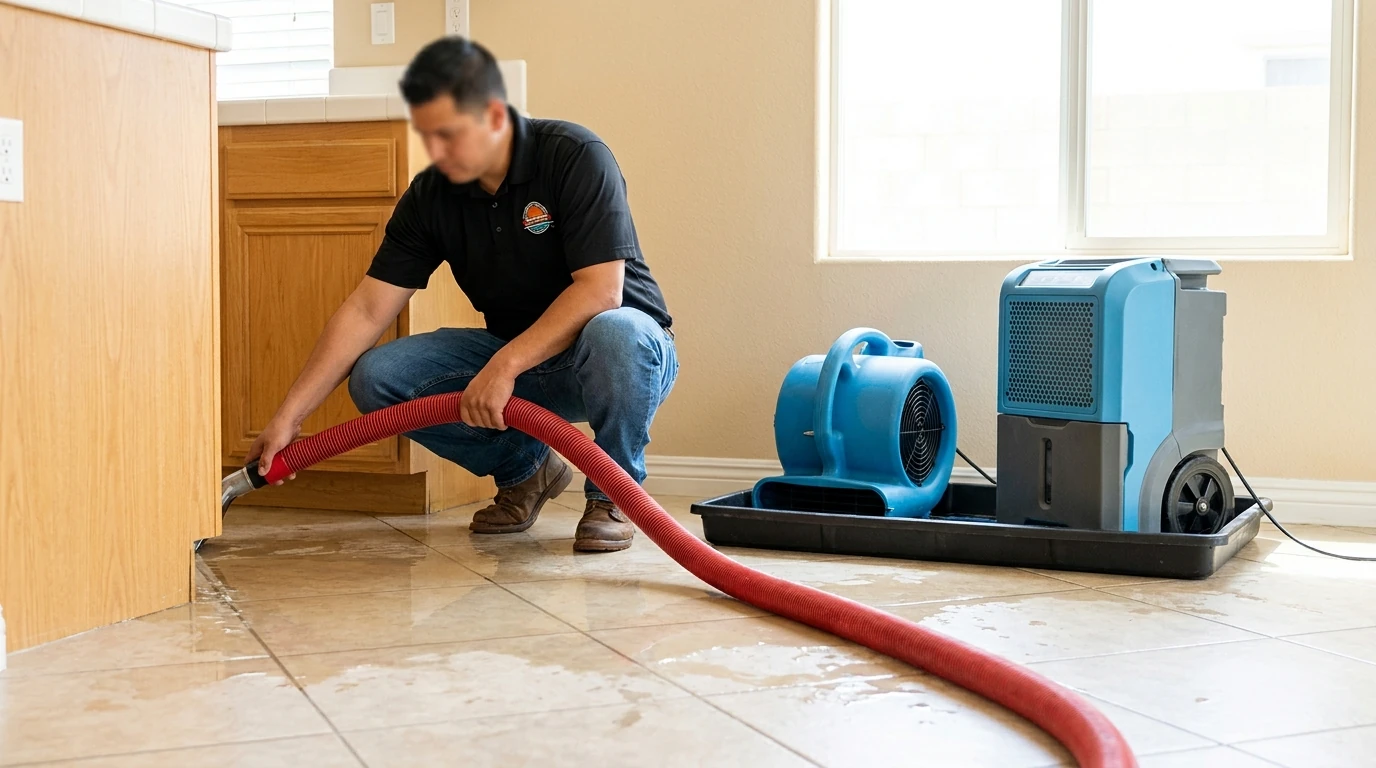
- Water extraction: Truck-mounted or portable extractors remove standing water. This step happens first and fast. Every hour of standing water increases saturation depth.
- Controlled demolition (if needed): Wet drywall, insulation, flooring, and cabinetry that cannot be dried in place are removed to expose the structural cavity. This is called a “flood cut” and is standard practice, not upselling.
- Structural drying: Blue axial air movers and LGR dehumidifiers are placed according to a drying plan. Equipment counts and placement follow the IICRC S500 standard. Daily moisture readings confirm progress. Average drying time is 3 to 5 days for a Class 2 loss.
- Antimicrobial treatment: Applied to any surface that had Category 2 or 3 contact, and to any area where drying was delayed.
- Final clearance moisture readings: Before equipment is removed, technicians confirm all readings are within acceptable dry standards.
- Rebuild: Once the structure is dry and cleared, reconstruction begins. Dry County Restoration handles the rebuild phase through general contracting so you are not managing two separate contractors.
If you are in the first 24 hours of a loss right now, the burst pipe emergency checklist walks you through what to do before the crew arrives.
What Should You Do Right Now?
If water is still entering the structure, stop the source first. Shut the main water supply valve or the valve at the failed fixture. If the source is a sewer line or you cannot identify it, call a plumber and a restoration company at the same time.
Once the source is stopped:
- Move valuables and electronics out of the wet area if it is safe to do so.
- Do not run a residential shop vac on contaminated water (Category 2 or 3). That spreads pathogens.
- Do not turn on ceiling fans or HVAC to “dry it out” before a moisture assessment. That can spread contamination and push humid air into wall cavities.
- Call for a professional moisture assessment. In Corona and throughout Southern California, Dry County Restoration responds 24/7.
Getting a written scope before work begins protects you. It tells you exactly what category and class the loss is, what materials are coming out, how many equipment days are planned, and what the rebuild phase involves. Never let a contractor start work without one.
Call Dry County Restoration at (951) 667-9910 for a same-day moisture assessment. We are IICRC-certified for water damage restoration (WRT) and structural drying (ASD), licensed and insured in California (license 1083555), and have served Corona and Southern California since 2020.
About Dry County Restoration
Dry County Restoration is an IICRC-certified firm serving Corona, Riverside, Anaheim, Ontario, and all of Southern California since 2020 (CA license 1083555). Their certified technicians hold IICRC credentials in Water Damage Restoration (WRT), Applied Structural Drying (ASD), and Applied Microbial Remediation (AMRT). Services include water damage restoration, mold remediation, fire damage restoration, sewage cleanup, storm damage restoration, emergency board-up and tarping, contents restoration, and general contracting for the rebuild phase.