TL;DR: Water damage in Chino, CA requires fast action. Stop the water source, document everything before touching it, and call a licensed restoration company within the first hour. Restoration typically runs $1,500 to $8,000 depending on how much water spread and how long it sat. Most homeowners insurance covers sudden, accidental losses. Mold can start growing in 24 to 48 hours, so speed matters more than anything else.
If you just walked into a flooded room in your Chino home near the Preserve or off Eucalyptus Avenue, you’re probably looking at soaked floors, wet drywall, and a sinking feeling about what comes next. The good news: water damage is highly treatable when you move quickly. The bad news: every hour you wait, the damage category climbs and the bill goes up. Here’s exactly what to do.
What Should I Do First When I Find Water Damage?
Shut off the water source immediately, then document the damage with photos and video before moving anything. Those two steps protect both your property and your insurance claim.
If the water is still flowing, find the shutoff valve for the affected fixture or turn off the main supply at the meter. Once the source is stopped, use your phone to photograph every affected surface: floors, walls, ceilings, baseboards, and any personal property in the water’s path. Do this before you move furniture or start mopping. Insurance adjusters and restoration crews both rely on that documentation to scope the loss accurately.
After you’ve documented, move valuables and electronics out of the wet area if you can do so safely. Avoid using electrical outlets or switches in the affected space until a professional clears them. Then call a restoration company. The IICRC S500 Standard for Professional Water Damage Restoration establishes that response time is the single biggest factor in limiting secondary damage, including mold growth.
For a full step-by-step checklist, see our post on what to do in the first 24 hours after water damage.
How Bad Is the Damage? Understanding Water Categories
Not all water damage is the same. The IICRC classifies water into three categories based on contamination level, and that classification drives both the cleanup method and the cost.
Category 1 (clean water) comes from a supply line, a faucet, or rain intrusion. It’s the least hazardous and the least expensive to remediate. A broken refrigerator line or a supply hose behind a washing machine typically falls here.
Category 2 (gray water) contains contaminants that can cause illness. Dishwasher overflow, washing machine discharge, and toilet overflow without solid waste are common examples. It requires more thorough extraction and antimicrobial treatment.
Category 3 (black water) is grossly contaminated. Sewage backups, floodwater from outside, and any Category 1 or 2 water that has sat long enough to grow bacteria fall into this group. Black water requires full containment protocols, PPE, and disposal of porous materials like drywall and carpet that absorbed it. If you’re dealing with a sewage backup, that’s a different scope entirely, see our sewage cleanup service for what that process involves.
The class of loss (how far the water spread and how deeply it penetrated) also matters. A Class 1 loss is a small area with minimal absorption. A Class 4 loss involves specialty drying for hardwood, concrete, or plaster that requires very low humidity levels and extended drying time.
How Long Does Water Damage Take to Dry?
A typical residential water damage job takes 3 to 5 days of active drying with professional equipment. Hardwood floors, thick subfloor assemblies, and wall cavities can take 5 to 7 days or longer.
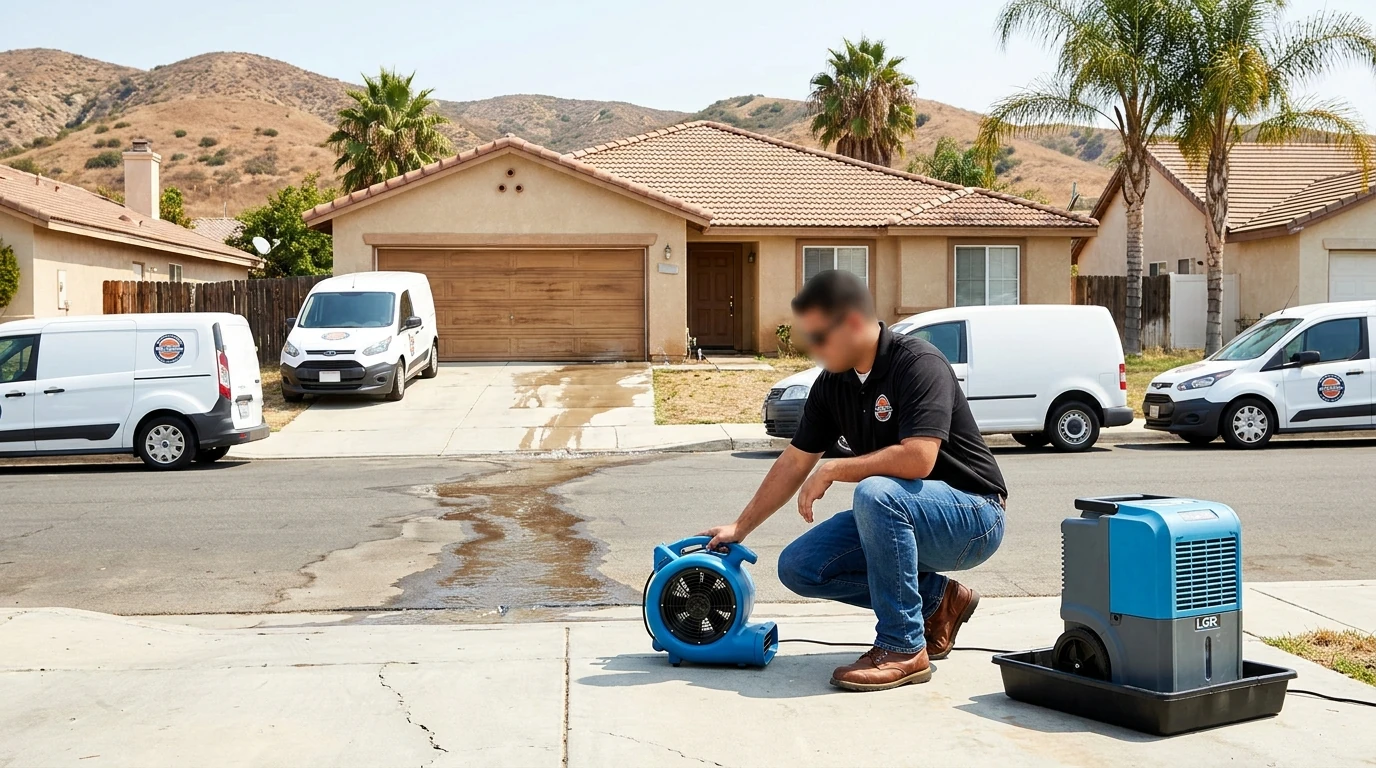
Professional drying is not just running fans. A certified crew sets up a system: truck-mounted or portable extraction removes standing water first, then axial air movers are positioned to create airflow across wet surfaces, and LGR (low-grain refrigerant) dehumidifiers pull moisture out of the air. Technicians take daily moisture readings with calibrated meters and adjust equipment placement based on the numbers. The goal is to reach dry standard, which the IICRC S500 defines as moisture content at or below the acceptable range for the material type.
Skipping professional drying and just running household fans is one of the most common mistakes Chino homeowners make. Household fans move air but don’t remove moisture from it. Humidity stays high, and wet materials stay wet inside wall cavities where you can’t see them. Three weeks later, you find mold.
Will My Insurance Cover Water Damage in Chino?
Most standard homeowners insurance policies cover sudden, accidental water damage but exclude gradual leaks and flooding from outside. The distinction matters a lot.
A burst pipe in the middle of the night: typically covered. A slow drip under the sink that rotted the cabinet over six months: typically excluded as a maintenance issue. Water that entered your home from street flooding or an overflowing creek: excluded from standard homeowners policies and only covered by a separate NFIP flood insurance policy through FEMA or a private carrier.
Chino’s location in San Bernardino County means some neighborhoods carry moderate flood risk, particularly near the Santa Ana River corridor. If you don’t have flood coverage and your damage came from outside the structure, document everything anyway and call your insurer to confirm the exclusion in writing before making any repairs.
For losses that are covered, the documentation you created in the first hour becomes your claim. A restoration company that handles insurance work will prepare a written scope of loss using Xactimate pricing, which is the industry-standard estimating platform most carriers accept. That scope protects you from underpayment. For more detail on how coverage actually works, see our guide on whether homeowners insurance covers water damage.
What Does Water Damage Restoration Cost in Chino?
Water damage restoration in Chino typically costs $1,500 to $8,000 for a residential loss, with most insurance claims landing in the $3,000 to $6,000 range after the deductible.
The biggest cost drivers are how much area was affected, what category of water it was, and how long it sat before extraction started. A Category 1 loss caught within two hours in a single bathroom is a very different job than a Category 2 washing machine overflow that soaked through to the subfloor and sat overnight. Hardwood floors are expensive to dry properly and often need to be replaced when they cup or buckle. Wet insulation in wall cavities almost always has to come out.
For a full breakdown of what moves the number, see our water damage restoration cost guide for California.
What Happens If I Wait?
Waiting 24 to 48 hours significantly increases both the damage scope and the total cost. After 48 hours, mold becomes a near-certainty in wet materials.
The EPA notes that mold can begin to grow on wet building materials within 24 to 48 hours under typical indoor conditions. Once mold is present, the job shifts from water mitigation to water mitigation plus mold remediation, which adds cost, time, and complexity. Porous materials that might have been saved with fast extraction often have to be removed once mold colonizes them.
Beyond mold, water that sits migrates. It follows gravity and capillary action into subfloor assemblies, wall cavities, and adjacent rooms. A loss that started in the laundry room can reach the living room floor within hours. The longer extraction is delayed, the more square footage is affected and the more material has to be replaced rather than dried in place.
If you’re also seeing signs of mold after a water event, the post on signs of hidden mold walks through what to look for before it becomes a larger problem.
Dry County Restoration responds to water damage calls in Chino around the clock. Their IICRC-certified crews handle extraction, structural drying, mold remediation, and the full documentation package your insurance adjuster will need. Call (951) 667-9910 to reach them any time, or request a water damage assessment online.
About Dry County Restoration
Dry County Restoration is an IICRC-certified firm based in Corona, CA, serving Chino and the broader Inland Empire since 2020 (CA License 1083555). Their certifications include WRT (Water Damage Restoration Technician), ASD (Applied Structural Drying), and AMRT (Applied Microbial Remediation Technician). The company is licensed, insured, locally owned, and available 24/7. Services include water damage restoration, mold remediation, sewage cleanup, fire damage restoration, storm damage restoration, water leak detection, emergency board-up and tarping, contents restoration, and general contracting.