
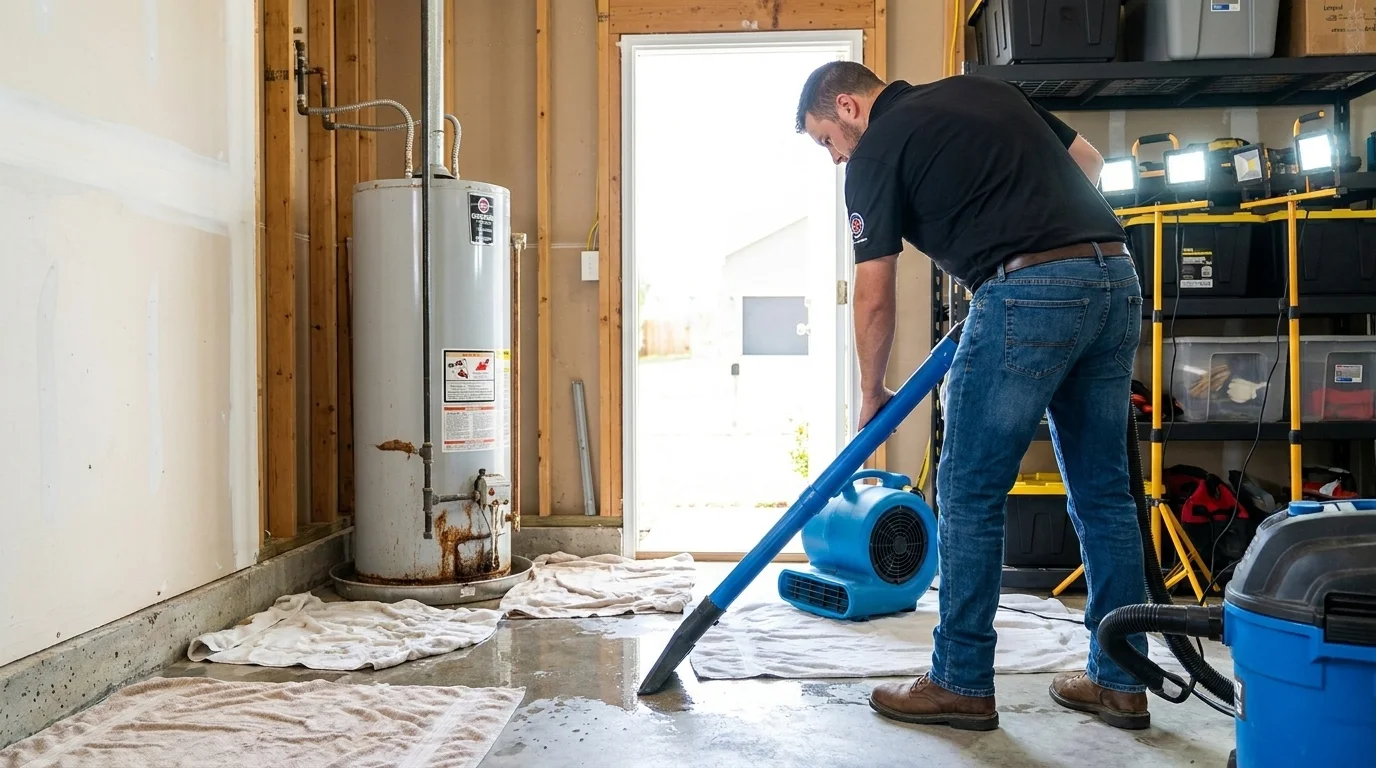
24/7 Emergency Water Heater Flood Cleanup in Corona
24/7 emergency water heater flood cleanup in Corona and surrounding areas. IICRC-certified, insurance billing accepted. Call (951) 667-9910.
Water heater flooding in Corona? Call (951) 667-9910. We answer 24/7 and can get a technician out to stop the water from spreading further into your home.
A failed water heater rarely announces itself with a dramatic flood. More often it starts as a slow drip from a corroded tank seam or a failed T&P valve, pooling quietly in a garage corner or closet for days before anyone notices the swollen baseboard or the musty smell creeping into the hallway. By the time it’s obvious, the water has usually already wicked into drywall, subfloor, or the wall cavity behind the unit, and a tank that fully ruptures can dump 40 to 80 gallons in minutes, sending water under doors and into adjoining rooms faster than most homeowners can react.
What water heater flood cleanup actually involves
The scope depends heavily on where the unit sits and how long the leak ran before discovery. A water heater in a garage with a floor drain and sloped slab contains water differently than one tucked into an interior closet next to a bedroom, where leaked water has nowhere to go but under the wall plate and into the adjacent room’s flooring. Our crews extract standing water first, then map moisture in the surrounding materials with meters and, where needed, thermal imaging to find water that’s traveled beyond what’s visible. Drying typically runs several days depending on what materials got wet and how enclosed the space is, monitored daily until materials read dry per IICRC S500 guidelines. If the leak sat for an extended period before discovery, we also check for early microbial growth in wall cavities and baseboards, since warm closets with standing water are a fast track to conditions mold needs to take hold.
Our process
- Shut down and source confirmation. We confirm the water supply, and gas or power to the unit, is off, then identify whether the failure is a tank rupture, a fitting leak, a failed T&P valve, or an overflowing drain pan, since that affects both water category and next steps for replacement.
- Extraction and unit staging. Standing water is pulled from the affected area, and if the unit needs to come out for the plumber to replace it, we coordinate that removal without disturbing exposed wiring or gas lines.
- Moisture mapping beyond the obvious area. Because water heaters often sit against a shared wall with living space, we check baseboards, adjacent flooring, and the wall cavity itself rather than stopping at the closet door.
- Targeted drying equipment. Confined closets and garage corners need different airflow than an open living room, so we use injectidry systems for wall cavities and compact air movers sized to the space rather than flooding it with oversized equipment that does little in a tight footprint.
- Daily monitoring and documentation. Moisture readings are logged until materials return to dry standard, with photos and readings that support your claim file.
What separates a good water heater flood response from a bad one
The most common miss is stopping at the visible wet spot. A water heater closet that shares a wall with a bedroom or hallway will often wick water into that adjacent wall cavity and flooring long before it shows on the surface, and an operator who doesn’t pull the baseboard or check with a moisture meter on the other side of that wall leaves a hidden problem to surface as mold or warped flooring weeks later. Another frequent error is treating all water heater leaks as clean water by default. A slow leak from a corroded tank can carry rust and sediment, and a leak that’s been running for days has different handling needs than one caught within hours. Adjusters pay attention to how quickly the source was documented, whether moisture readings were taken in adjacent rooms and not just the unit’s closet, and whether the water category was correctly identified rather than assumed.
What does water heater flood cleanup cost?
Typical costs scale with how long the leak ran and how far the water traveled before it was caught. Every loss is different, and Dry County Restoration provides a written scope before any work begins so you know what’s included before you approve it. Homeowners insurance typically covers sudden and accidental water heater failures, though gradual leaks that occurred over time, and the cost to replace the unit itself, are often handled differently in a policy, so it’s worth reading your declarations page or asking your adjuster directly.
| Scenario | Typical range |
|---|---|
| Garage slab leak, caught early, no adjacent rooms affected | $800 - $2,000 |
| Interior closet leak, drywall and baseboard affected | $1,500 - $3,500 |
| Leak traveled into adjacent bedroom or hallway flooring | $2,500 - $6,000 |
| Tank rupture, multi-room water travel | $4,000 - $9,000 |
| Undiscovered leak with early microbial growth in wall cavity | $5,000 - $12,000+ |
Seasonal and regional considerations
Corona’s hard water is tough on tank anodes and heating elements, and sediment buildup is a common contributor to early tank failure in homes with units past eight to ten years old. A lot of Corona’s housing stock, particularly the tract homes built from the 1970s through the 1990s, places water heaters in interior closets adjacent to bedrooms or hallways rather than detached garages, which means a leak has a shorter path to carpet and drywall than in homes with a garage-mounted unit and floor drain. Summer heat can also push garage temperatures high enough to stress an aging tank further, which is when we tend to see more failures.
Service area
We respond to water heater flood cleanup calls throughout Corona and the surrounding Inland Empire, including Eastvale, Norco, and nearby Riverside neighborhoods.
If your water heater is leaking or has already flooded a closet, garage, or adjoining room, call (951) 667-9910 to schedule your water damage assessment before the water spreads further or sits long enough to cause secondary damage.
Services We Handle
- Appliance Leak Cleanup
- Flood Cleanup
- Water Heater
Frequently Asked Questions
Does homeowners insurance cover water heater flood cleanup?
How do I know if my water heater leak is clean water or contaminated?
What happens to the wall behind my water heater closet?
How long does drying take after a water heater leak?
Can I just run fans myself instead of calling for cleanup?
Looking for the best water heater flood cleanup company in Corona?
Dry County Restoration provides licensed and insured water heater flood cleanup in Corona, CA and the surrounding area, and has served local property owners since 2020. Customers rate us 5.0 out of 5 stars across 91 Google reviews. We answer calls 24/7 — call (951) 667-9910 for immediate help.
Need Water Heater Flood Cleanup now?
We respond 24/7 across Corona and surrounding CA cities.