Mold Inspection and Testing in Corona
24/7 mold inspection and testing in Corona and surrounding areas. IICRC-certified, insurance billing accepted. Call (951) 667-9910.
A musty smell in a closet that won’t go away after you’ve cleaned it. A ceiling stain that keeps coming back even though the leak was fixed months ago. A family member with unexplained allergy symptoms that ease up when they’re away from the house. These are the moments that bring people to mold inspection and testing, not a visible wall of mildew but a nagging suspicion that something is growing where they can’t see it.
What mold inspection and testing actually involves
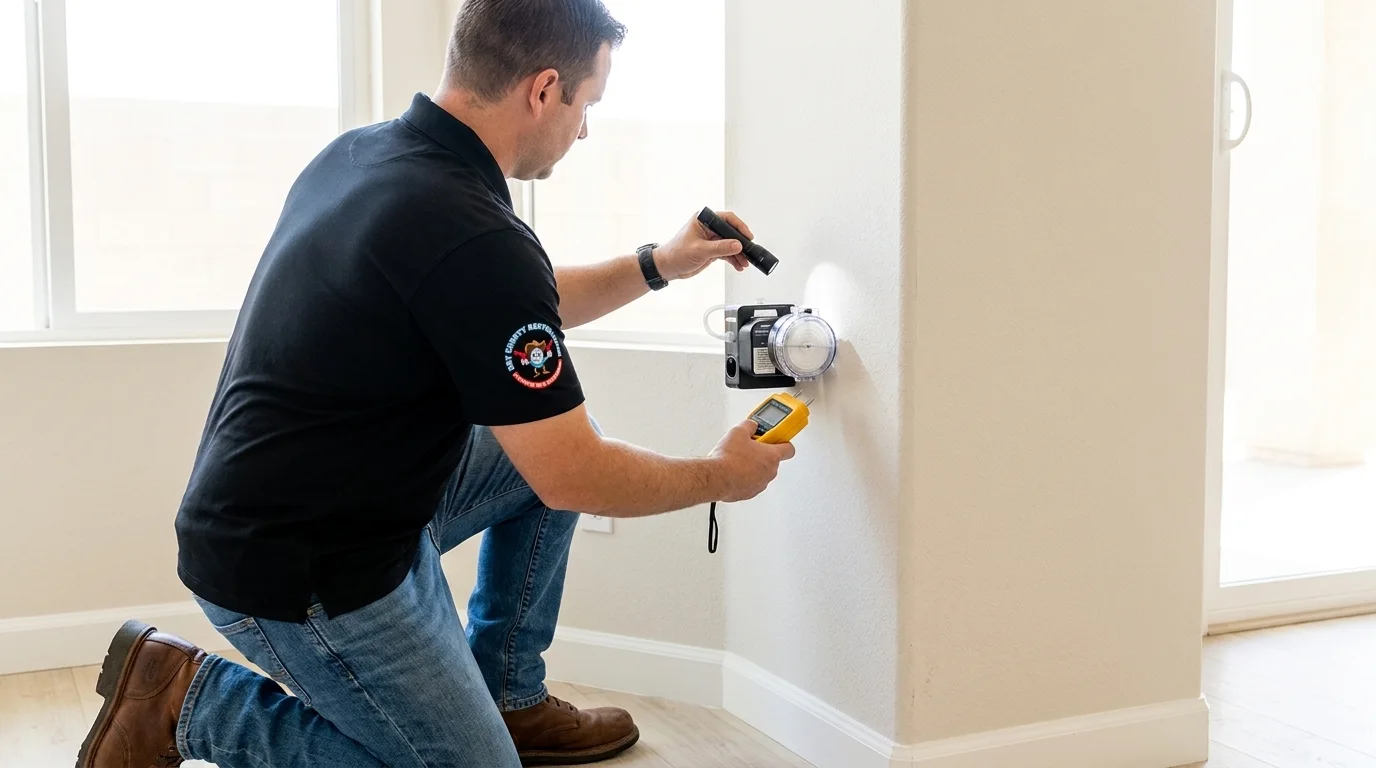
A proper mold inspection starts with a visual and moisture survey of the property, using a moisture meter and sometimes a thermal imaging camera to trace water intrusion back to its source, whether that’s a slow roof leak, a bathroom exhaust fan venting into an attic, or grading that pushes water toward a foundation. From there, testing can include air sampling to measure spore counts and compare indoor air quality against outdoor baseline levels, surface swabs on suspect material, and in some cases a bulk sample of drywall, insulation, or subfloor sent to an independent lab. Results typically take a few business days to come back, and they tell us not just whether mold is present but what genus is growing and in what concentration, which matters more than most homeowners expect: a reading that’s elevated for one mold type can be unremarkable for another.
Our process
- Interview and visual walkthrough. We ask about past leaks, musty odors, recent renovations, and health symptoms, then walk the property room by room looking for staining, bubbling paint, or warped baseboards.
- Moisture mapping. Using a moisture meter and thermal imaging where helpful, we identify active or historical water sources behind walls, under flooring, and in crawlspaces or attics.
- Sampling. Depending on what we find, we collect air samples, surface swabs, or bulk material samples, always including an outdoor control sample so lab results have a true baseline for comparison.
- Lab analysis and report. Samples go to a third-party lab, and we translate the results into a written report that identifies mold type, concentration, and likely cause, not just a pass or fail.
- Scope recommendation. If remediation is warranted, the report outlines what containment level and protocol the work calls for, so you can get accurate bids and your insurance carrier has documentation to work from.
What separates a good inspection from a bad one
The most common shortcut we see is a visual-only “inspection” that skips testing altogether and jumps straight to a remediation quote, sometimes from the same company that’s about to do the removal work, which is a conflict of interest worth asking about directly. A thorough inspection also checks places people forget: behind the washing machine, inside HVAC returns, under the kitchen sink cabinet floor, and in attic sheathing above bathrooms. Air sampling without an outdoor control sample is close to useless, since indoor spore counts mean little without something to compare them against. Insurance adjusters reviewing a mold claim want to see the moisture source documented and dated, lab chain-of-custody paperwork, and a clear link between a covered water event and the mold growth, since mold from a slow, undisclosed leak is often treated differently than mold following a sudden pipe burst.
What does mold inspection and testing cost?
Costs vary with the size of the property, the number of sample locations, and whether lab analysis is included or billed separately. Every property and every loss is different, which is why Dry County Restoration provides a written scope before any testing begins. Homeowners insurance typically covers mold testing when it’s tied to a covered water loss, such as a burst pipe, but ongoing or undisclosed moisture problems are often excluded, so it’s worth checking your policy language or asking your adjuster directly.
| Scenario | Typical range |
|---|---|
| Single room visual inspection, no lab testing | $200 - $450 |
| Visual inspection plus 2-3 air samples | $400 - $800 |
| Whole-house inspection with air and surface sampling | $800 - $1,500 |
| Post-remediation clearance testing | $300 - $600 |
| Specialty bulk material sampling (per sample) | $50 - $150 |
Seasonal and regional considerations
Corona’s dry summers and mild, wetter winters create two distinct windows worth watching. Indoor humidity tends to spike after winter rain events when roofs, windows, and crawlspace vents are tested, and mold can begin colonizing damp material within 24 to 48 hours of a leak going unnoticed. Summer brings the opposite risk: sealed-up homes running air conditioning can trap condensation around poorly insulated ductwork or attic penetrations, creating hidden moisture pockets even when outdoor air feels bone dry.
Service area
Dry County Restoration performs mold inspection and testing throughout Corona and the surrounding Inland Empire communities, serving a mix of older homes with original 1970s and 80s plumbing and newer construction where HVAC and attic ventilation issues are more common drivers of hidden moisture.
If something in your home smells off or a past leak has you wondering what’s happening behind the drywall, request an air quality test and get a clear answer, backed by lab data, instead of a guess. Call (951) 667-9910 to schedule.
Services We Handle
- Mold Inspection
- Mold Testing
- Water Damage Mold Inspection
Frequently Asked Questions
Does homeowners insurance cover mold inspection and testing?
What's the difference between mold testing and mold inspection?
How long does it take to get mold test results back?
Can I just use a home mold test kit from the hardware store instead?
What happens if the test comes back positive for mold?
Looking for the best mold inspection and testing company in Corona?
Dry County Restoration provides licensed and insured mold inspection and testing in Corona, CA and the surrounding area, and has served local property owners since 2020. Customers rate us 5.0 out of 5 stars across 91 Google reviews. We answer calls 24/7 — call (951) 667-9910 for immediate help.
Need Mold Inspection and Testing now?
We respond 24/7 across Corona and surrounding CA cities.