Large Loss and Catastrophic Response in Corona
24/7 large loss and catastrophic response in Corona and surrounding areas. IICRC-certified, insurance billing accepted. Call (951) 667-9910.
When a loss crosses a few thousand square feet, involves multiple structures, or shuts down a business, the standard residential playbook doesn’t scale. A single apartment building with water intrusion on four floors, a commercial kitchen fire that knocked out HVAC and electrical, or a multi-unit property hit by wind and flood in the same storm all need a different kind of response: more equipment staged faster, a documentation system that can survive a six-figure claim, and a crew structure that can run multiple zones at once without losing track of moisture readings, soot layers, or contents. Dry County Restoration runs large loss and catastrophic response out of Corona for property managers, commercial owners, and insurance carriers who need a team that can mobilize at scale and keep a claim organized from day one through final sign-off.
What large loss and catastrophic response actually involves
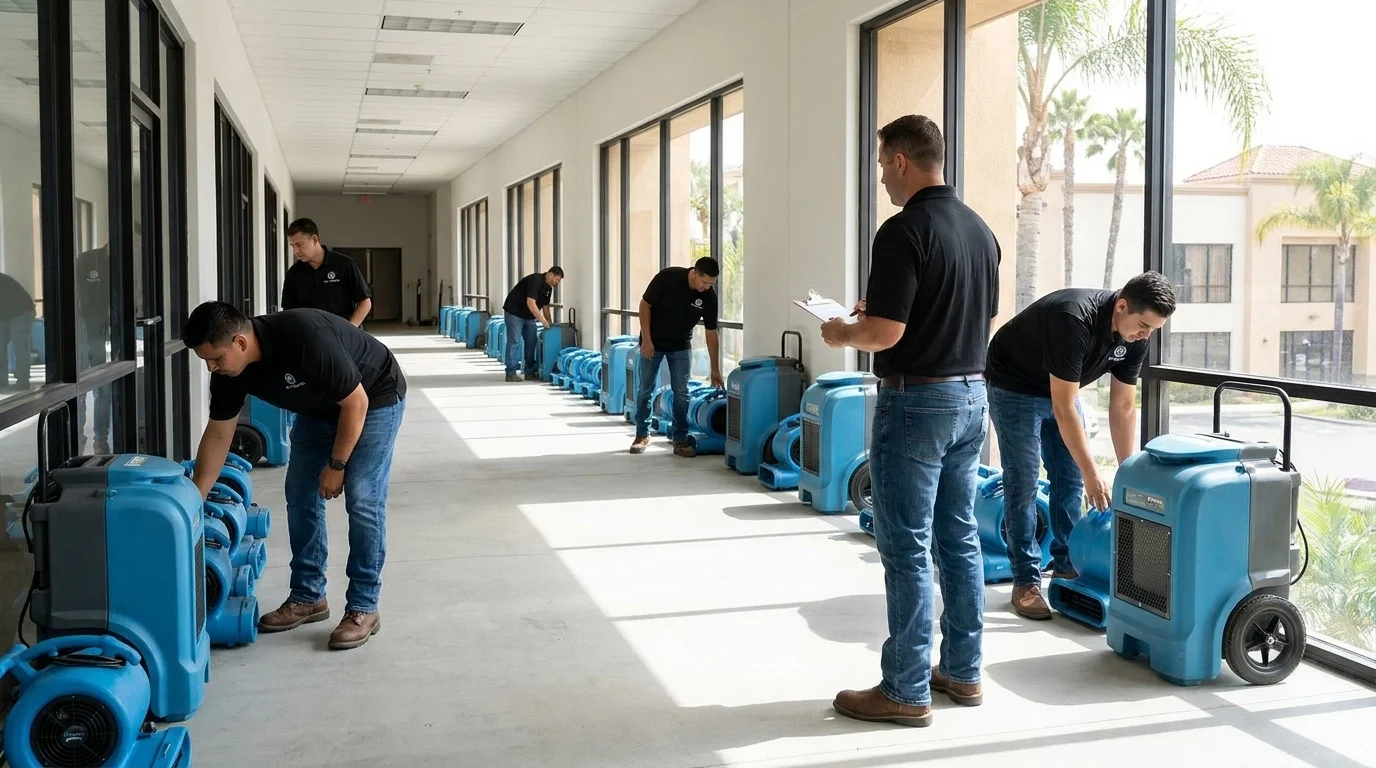
A large loss is typically defined by scope, not just dollar figure, though multi-million dollar restoration claims are common in this category: multiple affected units, mixed categories of damage (water, fire, wind) on one property, or a commercial operation where downtime itself is part of the loss. The work draws on the same core disciplines as residential water, fire, and mold work, structural drying per IICRC S500, soot and smoke protocols, antimicrobial application, but at a scale that requires psychrometric mapping across dozens of rooms, bulk equipment deployment (desiccant dehumidifiers, negative air machines, axial movers by the pallet), and a project management layer that tracks moisture logs, drying curves, and line-item costs across the entire structure simultaneously. Timelines run from days for a contained commercial flood to months for a catastrophic fire rebuild, and the first 24 to 48 hours of mitigation decisions usually determine how much of the structure is salvageable versus how much moves into reconstruction.
Our process
- Rapid site assessment and scope mapping. Before equipment moves in, the building gets zoned: which areas are affected, which categories of contamination are present, and which systems (electrical, HVAC, plumbing) need to be isolated before work starts.
- Mobilization and bulk equipment deployment. Large loss jobs need large loss equipment counts, truck-mounted extraction, commercial-grade dehumidification, air scrubbers for multiple containment zones, staged and running concurrently rather than sequentially.
- Multi-zone drying and monitoring. Moisture readings get logged by zone on a documented schedule, not spot-checked, so drying decisions and equipment pulls are defensible if an adjuster or engineer reviews the file later.
- Contents and structural triage. Salvageable contents are inventoried and either cleaned on-site or packed out; structural elements are evaluated for demolition versus drying based on material type and saturation depth.
- Documentation handoff and reconstruction transition. A complete file, photos, moisture logs, equipment run times, line-item scope, moves from mitigation into the reconstruction phase or directly to claim settlement.
What separates a good large loss response from a bad one
The failure point on big jobs is almost never the drying science, it’s coordination. Crews that aren’t used to catastrophic loss response tend to under-staff the first 24 hours, which lets secondary damage (mold colonization, additional material failure) catch up to the drying effort before it’s ever ahead of it. Documentation is the other gap: large loss adjusters expect zone-by-zone moisture logs, daily equipment counts, and photo-backed progress, not a single summary report at the end. A response that can’t produce that paper trail in real time tends to get claims disputed or delayed, which costs the property owner more than the mitigation itself. Good catastrophic response also means having a clear line between mitigation scope and reconstruction scope from day one, so the transition between phases doesn’t stall while everyone waits on a new estimate.
What does large loss and catastrophic response cost?
Costs on large loss claims vary enormously based on square footage, number of affected units, category of contamination, and whether structural demolition is needed, so the ranges below are industry-typical figures, not a quote. Every loss is different, and Dry County Restoration provides a written scope of work before mitigation begins so the property owner and carrier are working from the same numbers. Most commercial and large residential property policies cover large loss mitigation under the same water, fire, or wind damage provisions as a standard claim, though sublimits and business interruption coverage should be confirmed with the carrier early.
| Scenario | Typical range |
|---|---|
| Multi-unit water intrusion (4-8 units) | $25,000 - $90,000 |
| Commercial fire, single structure | $75,000 - $300,000 |
| Large residential catastrophic flood | $100,000 - $500,000 |
| Mixed-peril commercial loss (fire + water) | $200,000 - $1,000,000+ |
| Full structural reconstruction after large loss | $500,000 - multi-million dollar range |
Seasonal & regional considerations
Corona and the surrounding Inland Empire see two catastrophic risk windows: winter atmospheric river storms that can flood commercial basements and parking structures tied to the Santa Ana River watershed, and dry Santa Ana wind conditions in fall that elevate wildfire exposure to commercial and multi-family properties near the hillsides. Either event can turn a single-building incident into a multi-property large loss claim across a short stretch of days, which is when mobilization speed and equipment inventory matter most.
Service area
Dry County Restoration responds to large loss and catastrophic events throughout Corona and across Riverside and San Bernardino County communities including Norco, Eastvale, Chino Hills, and Riverside, mobilizing crews and equipment to commercial and multi-family properties as scope requires.
If your property has a loss that spans multiple units, systems, or buildings, don’t wait for a secondary inspection to figure out how big it is. Call (951) 667-9910 to get a large loss response team mobilizing and a written scope started today.
Frequently Asked Questions
Does homeowners or commercial insurance cover large loss and catastrophic response?
How is a large loss claim different from a standard residential restoration claim?
How fast can a large loss response team mobilize equipment for a multi-unit property?
What happens to salvageable contents during a catastrophic loss?
At what point does a large loss move from mitigation into reconstruction?
Looking for the best large loss and catastrophic response company in Corona?
Dry County Restoration provides licensed and insured large loss and catastrophic response in Corona, CA and the surrounding area, and has served local property owners since 2020. Customers rate us 5.0 out of 5 stars across 91 Google reviews. We answer calls 24/7 — call (951) 667-9910 for immediate help.
Need Large Loss and Catastrophic Response now?
We respond 24/7 across Corona and surrounding CA cities.