Industrial Restoration in Corona
24/7 industrial restoration in Corona and surrounding areas. IICRC-certified, insurance billing accepted. Call (951) 667-9910.
A tenant improvement warehouse with a sheared sprinkler head doesn’t behave like a flooded living room. Water spreads across thousands of square feet of slab, soaks into pallet racking and inventory, and travels under raised flooring and into electrical rooms before anyone notices the pressure drop. Industrial losses involve production downtime, equipment at risk, and documentation requirements that go well beyond a residential claim, which is why the response has to be scoped differently from the first call.
What Industrial Restoration actually involves
Industrial restoration covers water, fire, and smoke losses inside warehouses, distribution centers, manufacturing plants, and other large-footprint commercial buildings in and around Corona. The work differs from residential restoration mainly in scale and complexity: drying a 40,000 square foot warehouse floor requires a different equipment count and placement strategy than drying a bedroom, and a fire event on a production line brings soot into HVAC returns, control panels, and machinery housings that a homeowner’s fire loss never touches. Timelines run longer too. Structural drying on slab-on-grade industrial floors can take several days to a week depending on concrete thickness and moisture content, and equipment decontamination after smoke exposure often requires coordination with the facility’s own maintenance or engineering staff before machinery goes back online.
Our process
- Facility walkthrough and hazard identification. Before any equipment goes in, we identify electrical panels, lockout/tagout points, confined spaces, and any chemical storage areas that change how the loss has to be handled.
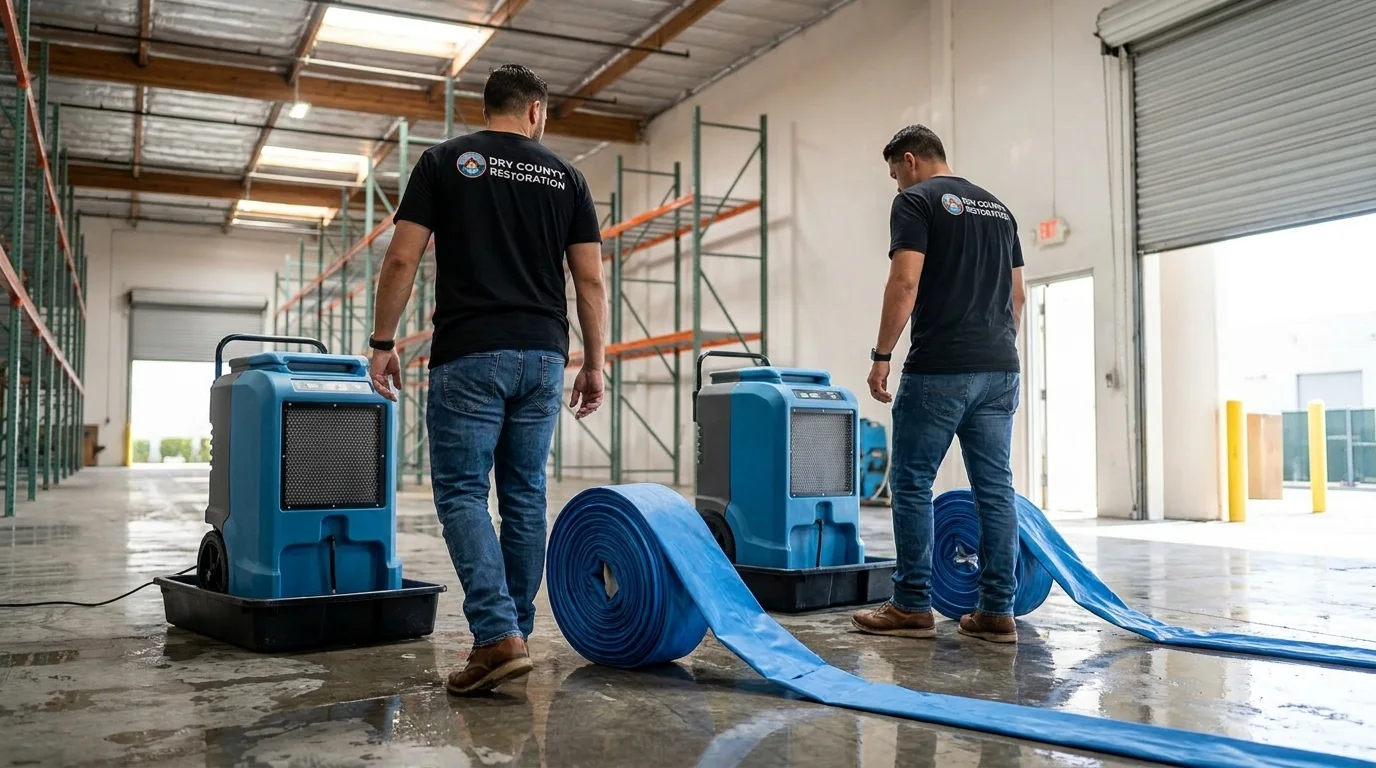
- Large-volume extraction and containment. Industrial-grade pumps and extraction units remove standing water fast, with physical containment barriers set up to keep affected zones separate from active production or storage areas.
- Moisture mapping across slab and structure. We use moisture meters and thermal imaging to track water movement through concrete, under raised flooring, and into wall assemblies and mezzanine framing, not just the visible wet areas.
- Equipment and asset protection. Machinery, racking, and electrical components exposed to water or soot get wiped down, dried, or treated to slow corrosion while the broader structure dries.
- Monitoring and documentation through dry-out. Daily or twice-daily moisture readings get logged and photographed, giving the facility and its insurance adjuster a clear record of progress from wet to dry.
What separates a good industrial restoration response from a bad one
The most common mistake on industrial losses is treating them like an oversized residential job: drop a few air movers, run them for a couple of days, and call it done. Concrete slabs hold moisture far longer than they appear to on the surface, and if drying stops early, trapped moisture under flooring or inside wall cavities shows up as a mold problem weeks later. A second common gap is corrosion control. Metal racking, electrical conduit, and exposed machinery start oxidizing within hours of water or smoke exposure, and skipping that step turns a water or fire claim into an equipment replacement claim. Adjusters reviewing industrial losses generally want to see documented moisture readings over time, clear before-and-after photos by zone, and a scope that accounts for both the structure and any affected contents or equipment, not just square footage dried.
What does Industrial Restoration cost?
Industrial restoration costs vary more than residential work because facility size, the category of water or type of fire damage, and the value of affected equipment all factor in. The ranges below reflect typical industry figures for this type of loss, not a quote. Every facility is different, and Dry County Restoration provides a written scope of work before any work begins so you know what’s included and what it costs.
| Scenario | Typical range |
|---|---|
| Localized warehouse water intrusion, under 5,000 sq ft | $8,000 - $20,000 |
| Large manufacturing floor water event | $25,000 - $75,000+ |
| Fire or smoke damage affecting a production line | $40,000 - $150,000+ |
| Equipment and contents decontamination | $5,000 - $30,000 |
| Structural drying with multi-day moisture monitoring | $3,000 - $10,000 |
Most commercial property policies cover sudden water, fire, and smoke losses to the building and sometimes business personal property, but equipment breakdown and business interruption often sit under separate endorsements, so it’s worth confirming coverage specifics with your carrier or broker before work starts.
Seasonal & regional considerations
Corona and the surrounding Inland Empire carry a dense concentration of warehouse and light-manufacturing space, much of it built with flat or low-slope roofing that’s prone to ponding during the region’s occasional heavy winter storms. Summer heat pushes interior temperatures high enough that drying equipment has to work against both ambient humidity and heat load, which changes placement and runtime calculations. Santa Ana wind events and nearby wildfire activity can also push smoke infiltration into large HVAC systems even when the fire itself is miles away, which is a different problem than a contained structure fire and calls for duct and filtration inspection as part of the response.
Service area
We respond to industrial and warehouse losses throughout Corona and the surrounding Inland Empire, including the distribution and manufacturing corridors in neighboring cities. Facility managers and property owners across the region call on us for both the emergency response and the follow-up drying, decontamination, and documentation work that comes after it.
If your facility has standing water, smoke intrusion, or fire damage on the floor right now, call (951) 667-9910 to get a crew and a written scope of work started.
Frequently Asked Questions
Does commercial or industrial insurance cover restoration after a warehouse water or fire loss?
How long does structural drying take in a large warehouse compared to a house?
Can production keep running while drying equipment is on-site?
What happens to machinery and equipment exposed to water or smoke?
What documentation does Dry County Restoration provide for commercial claims?
Looking for the best industrial restoration company in Corona?
Dry County Restoration provides licensed and insured industrial restoration in Corona, CA and the surrounding area, and has served local property owners since 2020. Customers rate us 5.0 out of 5 stars across 91 Google reviews. We answer calls 24/7 — call (951) 667-9910 for immediate help.
Need Industrial Restoration now?
We respond 24/7 across Corona and surrounding CA cities.