24/7 Emergency Board-Up and Tarping in Corona
24/7 emergency board-up and tarping in Corona and surrounding areas. IICRC-certified, insurance billing accepted. Call (951) 667-9910.
A broken window, a kicked-in door, a roof torn open by fire or wind, the damage that follows in the next few hours can dwarf whatever caused the opening in the first place. Rain gets in. Looters do too. Soot-laden air migrates into rooms that weren’t touched by flames. The building envelope is the first thing that has to close before anything else can be assessed or dried or rebuilt. That’s what emergency board-up and tarping is: not a cosmetic patch, but the first structural decision of the entire recovery.
What emergency board-up and tarping actually involves
Board-up and tarping is the process of mechanically securing every breach in a structure, windows, doors, wall openings, and roof penetrations, to stop weather intrusion, unauthorized entry, and the continued spread of damage from an already-active loss.
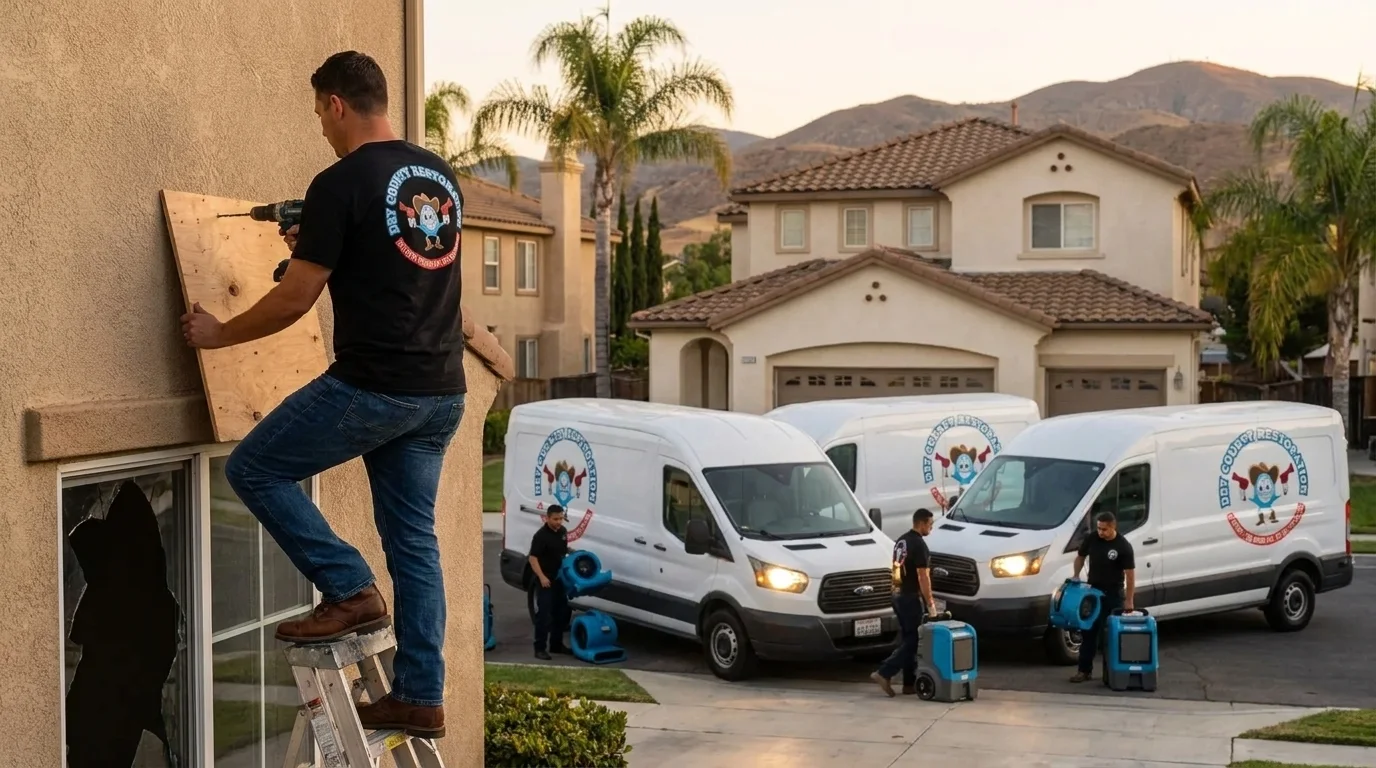
For window and door openings, crews cut and fasten plywood panels (typically ⅝” CDX) directly to the framing or surrounding masonry, not just taped over the glass frame. Openings left unsecured even overnight invite secondary water intrusion that can saturate subfloor assemblies, activate dormant mold spores within 24 to 48 hours, and turn a contained fire loss into a combined fire-and-water claim.
For roof damage, tarping involves laying and anchoring polyethylene sheeting, commercial-grade, not the blue hardware-store variety, over the damaged section, weighted and fastened at the ridge and eaves to withstand sustained wind. A tarp installed without ridge anchoring will peel back in the first Santa Ana condition, leaving the opening worse than before.
The work is fast by design: most openings can be secured within a few hours of arrival. The goal is not a finished repair, it’s a weathertight, secure structure that stops the clock on further loss.
Our process
-
Damage assessment and photo documentation. Before a single sheet of plywood is cut, every breach is photographed and measured. This documentation becomes part of the insurance claim file, adjusters need to see the condition of the opening before securing, not just after.
-
Hazard identification. Fire-damaged structures present specific entry hazards: compromised floor joists, live electrical panels, weakened roof decking. Crews identify these before committing weight to any surface. OSHA-trained technicians assess structural stability before staging materials inside.
-
Mechanical board-up of windows, doors, and wall openings. Plywood panels are cut to fit each opening and fastened to solid framing, not drywall, not window casing alone. Where masonry or stucco surrounds the opening, appropriate anchoring hardware is used. Every panel is labeled with the opening number that corresponds to the site diagram.
-
Roof tarping and anchoring. Tarps are laid from the ridge down, overlapping any adjacent intact roofing by at least two feet, and secured with batten boards screwed through the tarp into the roof decking, not sandbags, which shift. Ridge anchoring prevents wind uplift. The perimeter is sealed to reduce wind-driven rain from entering at the edges.
-
Final walkthrough and scope handoff. The completed board-up is re-documented with photos, and a written scope of the work performed is provided to the property owner and, when applicable, the insurance carrier. This scope is what the adjuster uses to authorize the next phase of work.
What separates a good board-up response from a bad one
The most common failure in board-up work isn’t the materials, it’s the anchoring. Plywood screwed only into window trim or vinyl casing will pull free under pressure. Roof tarps laid flat without ridge attachment become sails in the first wind event. These aren’t minor oversights; they’re the difference between a loss that stays contained and one that compounds overnight.
A second common failure is incomplete coverage. Crews in a hurry will board the obvious openings, the front windows, the door, and miss the attic vent knocked loose by the fire department, the crawlspace access that’s now exposed, or the HVAC chase that connects the fire-damaged wing to the rest of the house. Insurance adjusters reviewing a subsequent water or mold claim will ask whether all openings were secured. The site diagram and photo set from the initial board-up is the answer to that question.
Finally, documentation quality matters as much as the physical work. An adjuster cannot authorize coverage for secondary damage that occurred after board-up if there’s no timestamped record showing what was secured and when. Thorough pre- and post-board-up photography is not optional, it’s the evidentiary foundation of the claim.
Seasonal and regional considerations
In the Inland Empire and the Corona area specifically, two seasonal patterns drive the majority of emergency board-up calls. Santa Ana wind events, most frequent from October through March, generate the roof damage and broken-window calls that arrive in clusters after a single overnight wind. A structure left open after that kind of event faces immediate re-exposure if the next Santa Ana follows within days, which is common.
The second pattern is the post-fire window. After a wildland or structure fire, the combination of compromised roofing and the region’s dry, windy conditions means that even a small opening can allow significant particulate and weather intrusion within hours. Securing the structure before the next wind event is not a suggestion, it’s the difference between a recoverable loss and a total.
Service area
Dry County Restoration is based in Corona and responds to board-up and tarping calls throughout the surrounding Inland Empire and Riverside County communities, including Norco, Eastvale, Jurupa Valley, Riverside, Chino Hills, and Ontario. The city-specific pages for each area link back here for the full service detail. If you’re outside those cities, call (951) 667-9910 and we’ll confirm coverage.
If your structure has an opening that shouldn’t be there, the next step is straightforward: call (951) 667-9910 and get a crew moving toward your property. Dry County Restoration responds 24/7, the board-up happens tonight, not after the weekend.
Services We Handle
- Emergency Board Up
- Emergency Tarping
- Roof Tarps
Frequently Asked Questions
Does homeowners insurance cover emergency board-up and tarping?
How is a roof tarp properly anchored, and why does it matter?
What thickness and grade of plywood should be used for window and door board-up?
What should I do — and not do — while waiting for the board-up crew to arrive?
Does a board-up crew need to enter the structure, and do I need to be present?
Looking for the best emergency board-up and tarping company in Corona?
Dry County Restoration provides licensed and insured emergency board-up and tarping in Corona, CA and the surrounding area, and has served local property owners since 2020. Customers rate us 5.0 out of 5 stars across 91 Google reviews. We answer calls 24/7 — call (951) 667-9910 for immediate help.
Need Emergency Board-Up and Tarping now?
We respond 24/7 across Corona and surrounding CA cities.
Related Coverage
- Our Restoration Services
- Contact Dry County Restoration
- 24/7 Emergency Board-Up and Tarping in Anaheim
- 24/7 Emergency Board-Up and Tarping in Chino
- 24/7 Emergency Board-Up and Tarping in Chino Hills
- 24/7 Emergency Board-Up and Tarping in Fullerton
- 24/7 Emergency Board-Up and Tarping in Norco
- 24/7 Emergency Board-Up and Tarping in Ontario
- 24/7 Emergency Board-Up and Tarping in Riverside
- 24/7 Emergency Board-Up and Tarping in Santa Ana