24/7 Emergency Ceiling Water Damage Repair in Corona
24/7 emergency ceiling water damage repair in Corona and surrounding areas. IICRC-certified, insurance billing accepted. Call (951) 667-9910.
Water coming through your ceiling? A brown ring spreading across drywall, a soft sag overhead, or a steady drip from a light fixture means water has already soaked into the material above your head and is working its way down. We answer 24/7 at (951) 667-9910 because ceiling leaks rarely wait for business hours, and the longer that water sits in the cavity, the more likely the ceiling is to collapse or the drywall to host mold growth within 24 to 48 hours.
What Ceiling Water Damage Repair actually involves
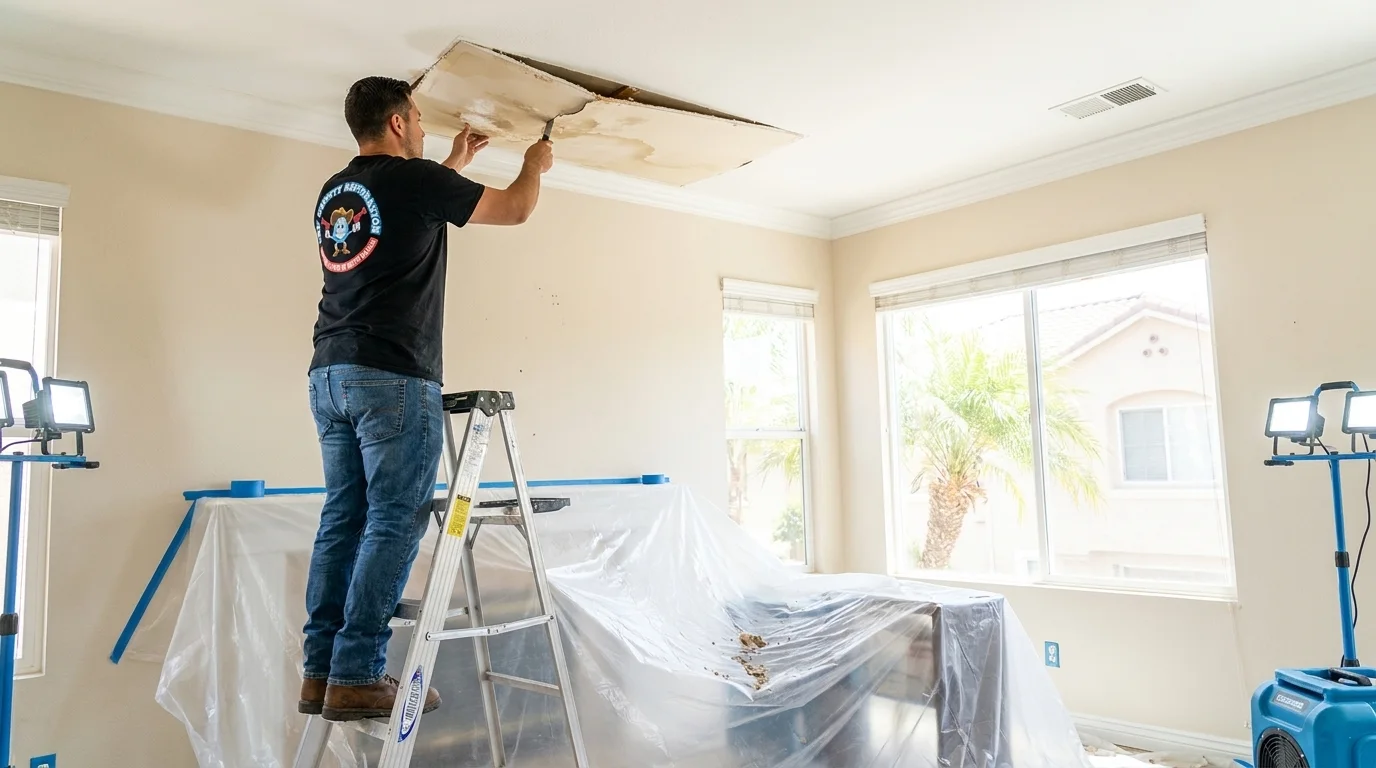
A leaking ceiling is almost never just a cosmetic stain. Water that reaches drywall has usually traveled from a roof penetration, a second-story bathroom, an HVAC condensate line, or a slab leak that wicked upward through a wall cavity. By the time you see a stain or feel a soft spot, the insulation above the ceiling, the drywall paper facing, and often the framing members have already absorbed moisture. Repair work starts with locating the actual source, not just the visible stain, since water travels along joists and settles far from where it first entered. From there, the job splits into two phases: drying and stabilizing the structure, then removing and replacing any ceiling material that has lost its integrity. Sagging drywall, blistered paint, and ceilings that flex or feel spongy when pressed cannot be dried in place and need to come down before mold has a chance to establish itself in the paper facing or insulation.
Our process
- Source identification and moisture mapping. We trace the leak back to its origin using moisture meters and, where needed, a thermal imaging camera to see how far the water has traveled inside the cavity before any demolition starts.
- Containment and controlled demolition. Sections of ceiling that are saturated, sagging, or structurally compromised are cut back to sound material, with plastic sheeting and negative air containment where the cavity shows signs of Category 2 or 3 water.
- Structural drying. Air movers and dehumidifiers are set per IICRC S500 drying standards, with daily moisture readings on the exposed framing, insulation, and surrounding drywall to confirm the cavity is actually drying, not just surface-dry.
- Insulation and drywall replacement. Wet batt or blown-in insulation is removed and replaced, new drywall is hung, taped, and finished to match the existing ceiling texture.
- Final moisture verification and paint. Framing and subfloor above are rechecked with a moisture meter before the new ceiling is closed up, then primed and painted to blend with the surrounding surface.
What separates a good ceiling water damage response from a bad one
The most common mistake is treating a ceiling stain as a paint problem. Painting over a water stain without addressing the moisture behind it just hides the signal homeowners rely on to catch the next leak, and it does nothing for insulation that’s already wet. Another frequent miss is drying the visible drywall surface while leaving wet batt insulation sitting against the back of it, which keeps feeding moisture back into the material for weeks. Adjusters reviewing a ceiling claim typically want documented moisture readings from before and after drying, photos of the insulation condition, and a clear explanation of why material was removed rather than dried in place. A ceiling that’s cut back further than the visible stain usually isn’t overreach, it’s often the technician following the actual wet area as mapped by the moisture meter, since staining on the painted surface rarely matches the full wet footprint in the cavity above it.
What does Ceiling Water Damage Repair cost?
Cost depends on how much of the ceiling has to come down, whether insulation and framing need replacing, and how much texture or trim matching the finish work requires. Every loss is different, which is why Dry County Restoration provides a written scope before any work begins. Most homeowners insurance policies cover ceiling water damage repair when the source is sudden and accidental, such as a burst supply line or a failed water heater, but typically exclude damage from long-term roof leaks or lack of maintenance.
| Scenario | Typical range |
|---|---|
| Small stained area, drywall intact, no demo needed | $300 - $800 |
| Single room, localized drywall cut-out and patch | $800 - $2,200 |
| Full ceiling section replacement with insulation | $2,200 - $5,500 |
| Multi-room or second-story leak affecting ceilings below | $4,000 - $9,000 |
| Textured or vaulted ceiling requiring specialty finish match | $1,500 - $4,000 additional |
Seasonal & regional considerations
Corona’s hot, dry summers put extra stress on roof flashing and attic HVAC lines, and when the Inland Empire gets its winter rain, older flashing and roof penetrations that held up fine all summer are often where the first ceiling leaks show up. Homes in the area with tile roofs and older composite shingle roofs both see leak points at valleys and vent boots, and a second-story bathroom leak is one of the most common ceiling-damage calls we see regardless of the season.
Service area
We repair water-damaged ceilings throughout Corona and the surrounding Inland Empire communities, including Norco, Eastvale, Riverside, and Lake Elsinore. Our license (#1083555) and IICRC-trained technicians cover both single-story homes and multi-unit properties where a leak on one floor affects ceilings below.
If water is actively coming through your ceiling or a section feels soft and ready to give way, stop stalling and get the source identified before the drywall fails. Call (951) 667-9910 to schedule your ceiling water damage assessment and get a written scope of repair started today.
Services We Handle
- Ceiling Dry
- Ceiling Leak Water Damage
- Ceiling Leaks
- Ceiling Water Damaged
- Leak in Ceiling
Frequently Asked Questions
Does homeowners insurance cover ceiling water damage repair?
How do I know if my sagging ceiling is about to collapse?
Can a ceiling be dried out without replacing the drywall?
Why does the water stain on my ceiling look small but the repair area is so much larger?
How long does a typical ceiling leak repair take from start to finish?
Looking for the best ceiling water damage repair company in Corona?
Dry County Restoration provides licensed and insured ceiling water damage repair in Corona, CA and the surrounding area, and has served local property owners since 2020. Customers rate us 5.0 out of 5 stars across 91 Google reviews. We answer calls 24/7 — call (951) 667-9910 for immediate help.
Need Ceiling Water Damage Repair now?
We respond 24/7 across Corona and surrounding CA cities.