24/7 Emergency Basement Flooding Cleanup in Corona
24/7 emergency basement flooding cleanup in Corona and surrounding areas. IICRC-certified, insurance billing accepted. Call (951) 667-9910.
Basement flooding in Corona? Standing water below grade turns into a structural problem fast, soaking into concrete, block walls, and whatever framing or finished materials sit against them. We answer 24/7 and bring truck-mounted extraction equipment built for below-grade water, not just surface moisture.
What Basement Flooding Cleanup actually involves
A flooded basement behaves differently than a flooded upstairs room. Water pools against the lowest point of the structure, soaks into porous concrete and CMU block, and often has nowhere to drain on its own. Depending on the source, cleanup can mean anything from a few inches of clean water after a sump pump failure to several feet of groundwater intrusion after a heavy storm, or contaminated water from a sewage backup through a floor drain.
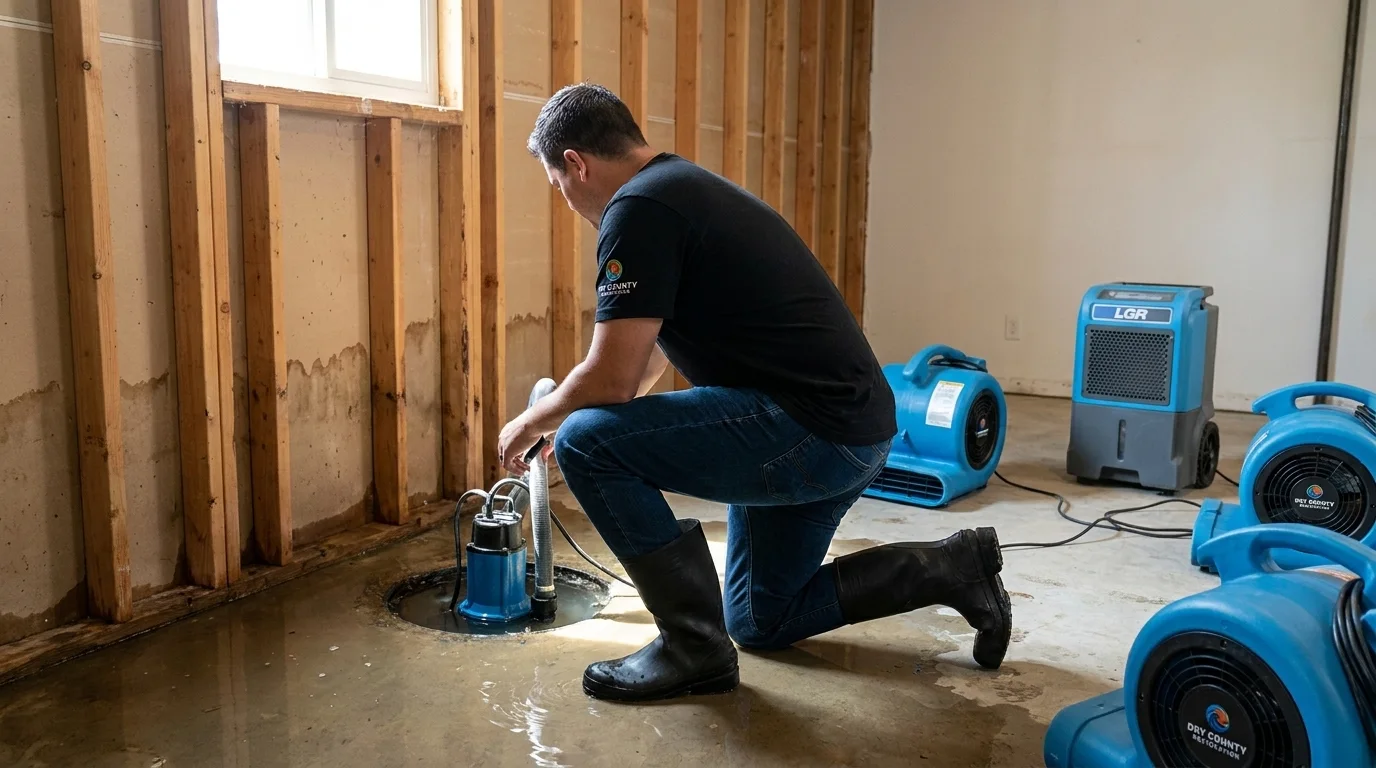
Our crews run submersible pumps to remove bulk standing water, followed by truck-mount or portable extraction for what’s absorbed into flooring and baseboards. From there it’s structural drying: commercial dehumidifiers sized for the cubic footage of the space, air movers positioned to pull moisture out of wall cavities, and in finished basements, selective removal of drywall or baseboard that’s wicked water past the point of salvage. Below-grade spaces hold moisture longer than rooms above ground because concrete and block are slower to release what they’ve absorbed, so the drying window usually runs longer than a comparable upstairs loss.
Our process
- Source and water category assessment. Before anything else, we identify what’s feeding the water, a failed sump pump, a cracked foundation wall, groundwater seepage, or a sewage backup, and classify it as Category 1, 2, or 3 water under IICRC S500 guidelines. That classification drives every decision that follows.
- Bulk water extraction. Submersible pumps clear standing water first, then extraction wands and truck-mount equipment pull saturated moisture from flooring, carpet pad, and baseboard.
- Removal of non-salvageable materials. Drywall, insulation, and flooring that have wicked water above a safe threshold get cut out and removed rather than dried in place, especially on anything touched by Category 2 or 3 water.
- Structural drying with daily monitoring. Dehumidifiers and air movers run until penetrating moisture meter readings on the concrete, block, and remaining framing return to a dry standard, not just until the space looks dry.
- Final moisture verification before close-up. Before any rebuild starts, we document moisture content across the affected area so there’s a clear record the structure was dry before new materials go in.
What separates a good basement flooding response from a bad one
The most common mistake is treating a basement like any other wet room: pull the water, run a couple of fans, call it done. Concrete and block walls hold moisture well below the surface, so a basement can read dry on a moisture meter at the drywall and still be saturated behind it. Operators who skip penetrating moisture readings on the block itself, not just the finished surface, often close up a space that’s still wet, which shows up as mold or efflorescence weeks later.
Another gap is source control. Drying a basement without addressing why it flooded, a failing sump pump, a grading issue sending water toward the foundation, a cracked wall, just resets the clock until the next storm. Insurance adjusters pay close attention to documented cause of loss, moisture logs showing daily readings, and photos of affected materials before removal, because sump pump failure, groundwater seepage, and sewage backup are often handled differently under a policy. Thorough documentation at the start protects the claim later.
What does Basement Flooding Cleanup cost?
Costs vary widely based on water category, how much of the basement is finished, and how long water sat before cleanup started. These are typical industry ranges, not a quote, since every loss is different and we provide a written scope before any work begins. Homeowners insurance often covers sudden, accidental losses like a sump pump failure or burst pipe, but typically excludes gradual seepage or flood water without separate flood coverage, so it’s worth reviewing your policy language before assuming coverage.
| Scenario | Typical range |
|---|---|
| Sump pump failure, clean water, small area | $1,500 - $4,000 |
| Unfinished basement, structural drying only | $1,200 - $3,000 |
| Groundwater seepage, larger affected area | $3,000 - $7,000 |
| Finished basement, drywall and flooring loss | $4,000 - $10,000 |
| Sewage backup cleanup | $5,000 - $15,000 |
Seasonal & regional considerations
Corona sees its heaviest rain during winter atmospheric river events, when several inches can fall in a short window after months of dry ground. The clay-heavy soil common across the area swells when saturated and can put pressure on foundation walls faster than homeowners expect, which is when sump pumps and French drains that have sat unused all summer tend to fail. Basements are less common in Southern California housing stock overall, but where they exist, below-grade waterproofing and drainage were often built for a drier, more predictable climate than the one these storms deliver.
Service area
We handle basement flooding cleanup for homeowners in Corona and throughout the surrounding Inland Empire, including Eastvale, Norco, Riverside, and Chino Hills.
If your basement has standing water right now, stop walking through it and call (951) 667-9910. Schedule your basement water removal and let us put eyes on the source before another storm makes it worse.
Services We Handle
- Basement Flood Cleanup
- Sump Pump Failure Cleanup
Frequently Asked Questions
Does homeowners insurance cover basement flooding cleanup?
How is water in a flooded basement categorized, and why does it matter?
How long can standing water sit in a basement before mold becomes a concern?
What should I do while waiting for a crew to reach my flooded basement?
Why does drying a basement take longer than drying a room upstairs?
Looking for the best basement flooding cleanup company in Corona?
Dry County Restoration provides licensed and insured basement flooding cleanup in Corona, CA and the surrounding area, and has served local property owners since 2020. Customers rate us 5.0 out of 5 stars across 91 Google reviews. We answer calls 24/7 — call (951) 667-9910 for immediate help.
Need Basement Flooding Cleanup now?
We respond 24/7 across Corona and surrounding CA cities.