Air Duct Cleaning in Corona
24/7 air duct cleaning in Corona and surrounding areas. IICRC-certified, insurance billing accepted. Call (951) 667-9910.
When the same air cycles through your home dozens of times a day, whatever is living inside your ductwork comes with it. Dust mite debris, rodent droppings, construction-era drywall dust, mold spores from a long-forgotten slow leak, none of it is visible from a vent cover, but all of it is airborne every time your HVAC system kicks on. If your filters are clogging faster than they used to, if certain rooms smell musty the moment the heat runs, or if someone in the house is waking up congested despite clean bedding, the duct system is often where the investigation should start.
What air duct cleaning actually involves
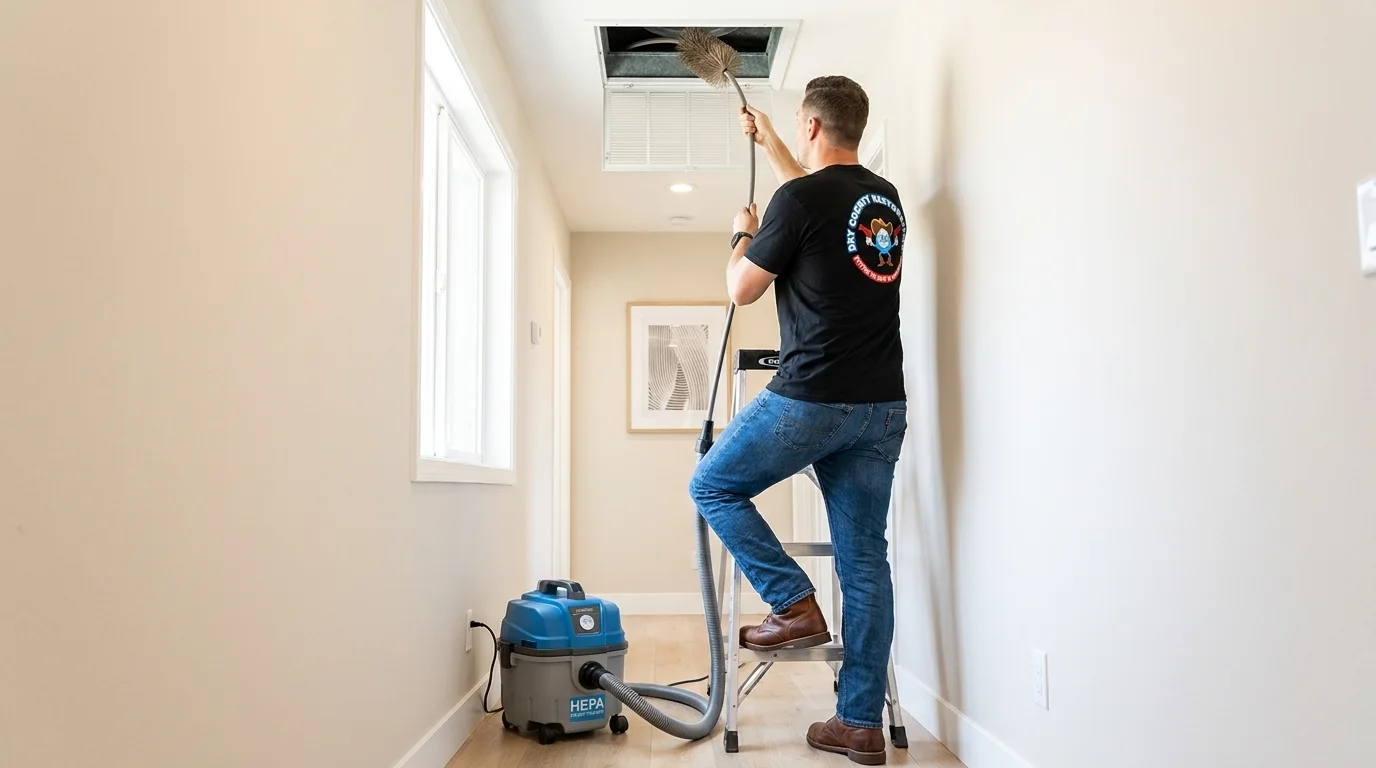
Air duct cleaning is not a shop-vac run through the nearest register. A proper cleaning requires access to the full duct network, supply lines, return lines, the air handler cabinet, and the blower compartment, using negative-pressure equipment that prevents loosened debris from redistributing into living spaces.
The industry standard tool is a truck-mounted or high-powered portable vacuum system connected directly to the main trunk line, creating continuous negative pressure throughout the duct system while technicians use rotary brush agitation tools to break contamination loose from duct walls. Flex duct, sheet metal, and fiberboard duct board each require different brush speeds and contact pressure to avoid damage. On older systems, and Corona’s housing stock includes a meaningful share of homes built in the 1970s and 1980s with original fiberboard ductwork, aggressive brushing can delaminate the interior lining and introduce a new contamination problem.
A full residential cleaning typically runs two to four hours for a standard single-story home. Multi-story homes, homes with extensive flex duct runs, or systems that haven’t been cleaned in a decade or more will take longer. Dryer vent cleaning is a separate scope and should be done at the same visit when accessible, lint accumulation in dryer exhaust lines is a documented fire cause, and the cleaning method differs from HVAC duct work.
If microbial growth is confirmed or suspected, visible mold inside a supply plenum, a persistent musty odor after mechanical cleaning, air duct sanitization with an EPA-registered antimicrobial agent applied by ULV fogger is the appropriate follow-on step.
Our process
-
System inspection and photo documentation. Before any equipment is connected, a technician walks the system, locating every supply and return register, checking the air handler and blower wheel condition, and photographing the interior of accessible duct sections. This establishes baseline contamination and identifies any damaged flex duct, disconnected joints, or signs of moisture intrusion that would change the scope of work.
-
Negative-pressure setup. The main collection unit connects to the largest accessible trunk line or plenum. All registers are sealed with temporary covers to maintain system-wide negative pressure. This step is what separates a professional cleaning from a blow-and-go, without continuous negative pressure, agitation simply moves debris from one section of duct to another.
-
Mechanical agitation, section by section. Technicians work register by register, opening one cover at a time and running rotary brush tools through each branch run back toward the trunk. Supply and return sides are worked separately. The blower compartment and air handler cabinet are hand-cleaned with HEPA-filtered vacuums.
-
Dryer vent cleaning (when in scope). The dryer exhaust line is cleared with a rotary brush system from the exterior termination point inward. Lint traps in the wall cavity and at the transition hose are checked and cleared. The exterior damper is inspected for proper operation.
-
Post-cleaning verification and sanitization (if applicable). After mechanical cleaning, the technician re-inspects duct interiors with a camera or inspection mirror. If microbial contamination was identified in step one, EPA-registered sanitizer is applied by ULV fogger with all registers open and the system fan running to ensure full distribution. A final walkthrough confirms all register covers are re-secured and the system is operating normally.
What separates a good duct cleaning from a bad one
The most common shortcut in residential duct cleaning is skipping negative pressure entirely, a technician with a portable vacuum and a brush who works register to register without sealing the system is essentially redistributing debris rather than removing it. You may smell a temporary improvement as the surface layer clears, but settled contamination deeper in the trunk lines stays in place.
A second frequent gap is ignoring the air handler cabinet and blower wheel. The blower wheel accumulates the same debris as the duct walls, and a contaminated blower wheel reintroduces particulates into the airstream immediately after cleaning. Any scope of work that doesn’t include the air handler interior is incomplete.
For insurance-related duct cleaning, most often triggered by fire or smoke damage where soot has entered the HVAC system, or by water damage where a flooded air handler has allowed mold to colonize supply lines, adjusters will look for photo documentation of pre- and post-cleaning conditions, the cleaning method used (negative pressure vs. contact vacuum), and whether sanitization was applied and with what registered product. Verbal assurances don’t satisfy a supplement request; a written scope with before-and-after photos does.
Fiberboard duct board interiors that show active mold growth typically cannot be cleaned to an acceptable standard and require replacement, a scope determination that should be made before cleaning begins, not after a brush run has further damaged the liner.
Seasonal and regional considerations
In the Inland Empire, HVAC systems run hard. Summers in Corona regularly push past 100°F, meaning air handlers cycle almost continuously from June through September. That sustained runtime accelerates debris accumulation on blower wheels and filter media, and it means any microbial contamination in the duct system has months of warm, circulated air to spread through.
The Santa Ana wind season, typically late fall through early spring, pushes fine particulate matter through every gap in a building envelope. Homes with older duct systems and leaky connections at registers or flex duct joints pull that outdoor particulate directly into return air. After a significant wind event, it’s worth checking return-side filters; heavy loading in a short period is a reasonable indicator that the duct interior has taken on debris as well.
Homes built during Corona’s major growth periods in the 1980s and 1990s often have original flex duct that has become brittle or partially collapsed over time. Collapsed sections restrict airflow and create pockets where debris settles and moisture can accumulate, a condition worth identifying during the inspection phase before cleaning begins.
Service area
Dry County Restoration is based in Corona and serves communities throughout the Inland Empire and surrounding areas, including Riverside, Norco, Eastvale, Chino Hills, Ontario, Rancho Cucamonga, and the foothill communities to the north and west. Each city-specific service page covers local considerations in more detail.
If your home or property is outside these areas, call (951) 667-9910, coverage questions are answered directly.
If your HVAC system is overdue for cleaning, or if a recent water, fire, or smoke event may have compromised your ductwork, call (951) 667-9910 to schedule an inspection and get a written scope before any work begins.
Services We Handle
- Air Duct & HVAC Cleaning
- HVAC Cleaning
Frequently Asked Questions
Does homeowners insurance cover air duct cleaning?
How do I know if my ducts actually need cleaning versus just a filter change?
What is the difference between air duct cleaning and air duct sanitization, and do I need both?
Can air duct cleaning damage older flex duct or fiberboard ductwork?
Should dryer vent cleaning be done at the same time as HVAC duct cleaning?
Looking for the best air duct cleaning company in Corona?
Dry County Restoration provides licensed and insured air duct cleaning in Corona, CA and the surrounding area, and has served local property owners since 2020. Customers rate us 5.0 out of 5 stars across 91 Google reviews. We answer calls 24/7 — call (951) 667-9910 for immediate help.
Need Air Duct Cleaning now?
We respond 24/7 across Corona and surrounding CA cities.