TL;DR: If you find mold in your Chino Hills home, the first step is stopping the moisture source that feeds it. Small patches under 10 square feet can sometimes be handled yourself; anything larger, hidden, or involving black or green colonies needs a certified professional. Remediation typically takes 1-5 days depending on the extent of growth. Most homeowners insurance policies cover mold only when it results from a covered water loss, so documentation matters from day one.
You noticed a musty smell in the hallway near the upstairs bathroom, or maybe you pulled back the vanity cabinet and found dark staining on the drywall. Now you’re wondering how serious it is, whether it’s the toxic kind, and what it’s going to cost you. Those are the right questions. Chino Hills homes, particularly the newer construction in areas like Soquel Canyon and the Carbon Canyon corridor, are tightly sealed for energy efficiency, which means moisture that gets in has fewer ways to get out. That combination of trapped humidity and Southern California temperature swings creates real conditions for mold growth, even in a dry climate.
What exactly is mold, and when is it a health risk?
Mold is a fungus that reproduces by releasing microscopic spores into the air. It grows on any organic material, including drywall paper, wood framing, insulation, and carpet, when moisture is present and the surface stays damp for 24-48 hours or longer. The EPA’s mold guidance notes that there is no practical way to eliminate all mold spores indoors; the goal is controlling moisture so mold cannot establish colonies.
Not all mold is equally hazardous, but any active colony is a problem worth addressing. The species commonly called “black mold” (Stachybotrys chartarum) requires sustained moisture over weeks and produces mycotoxins that can aggravate respiratory conditions. But plenty of common mold species, including Cladosporium and Penicillium, cause allergic reactions, eye irritation, and worsened asthma at high exposure levels regardless of color. Color alone does not tell you what you’re dealing with. If you want a definitive answer, an air sample or surface swab analyzed by an accredited lab will. Our post on how to test for mold walks through the difference between DIY kits and a professional inspection.
The groups most at risk: children under 12, adults over 65, anyone with asthma or a compromised immune system, and pregnant women. If anyone in your household falls into these categories, err toward professional remediation rather than DIY cleanup.
How does professional mold remediation actually work?
Professional mold remediation follows the IICRC S520 Standard for Professional Mold Remediation, which defines the scope, containment requirements, and clearance testing protocols that certified firms must meet. The process has five core phases.
-
Assessment and moisture mapping. A technician uses a thermal imaging camera and pin-type moisture meters to find both visible growth and hidden moisture behind walls or under flooring. You cannot remediate effectively without knowing the full extent of the problem.
-
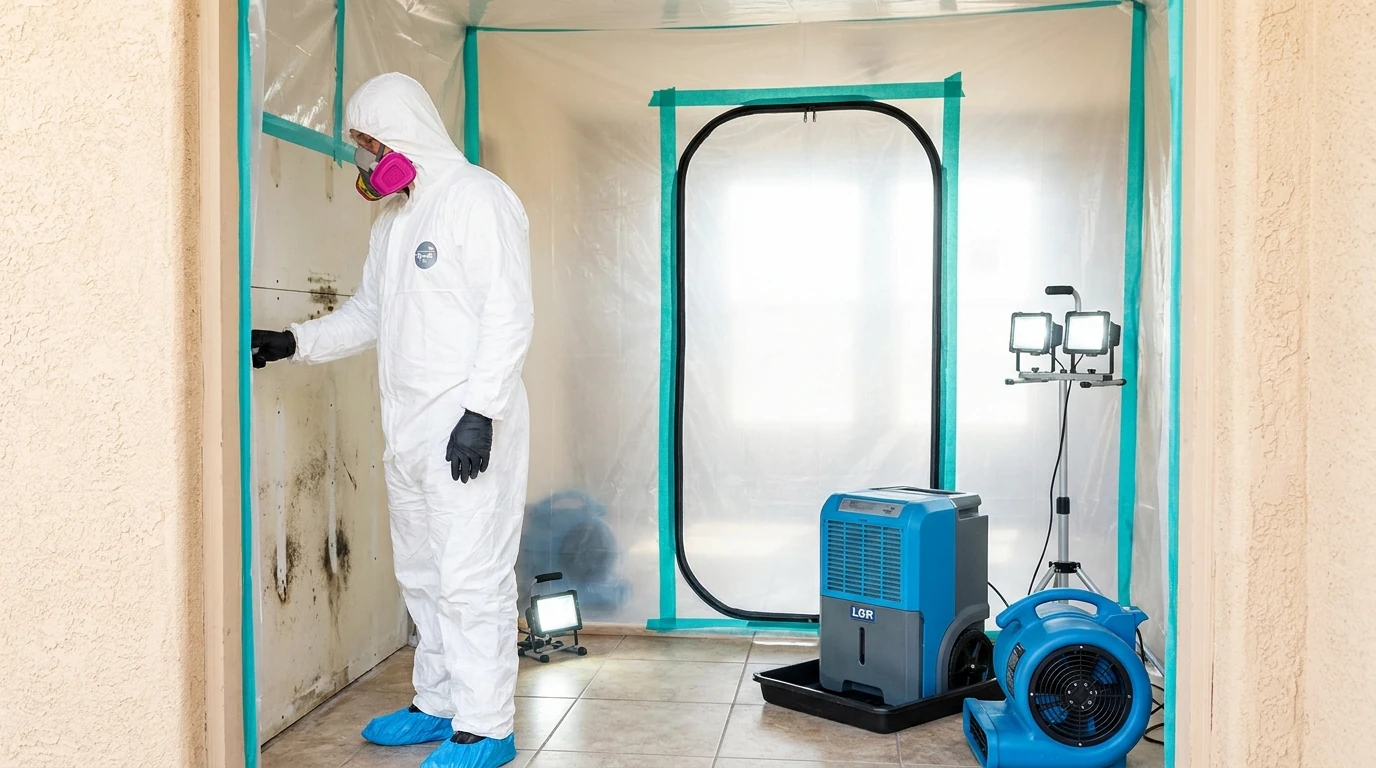
Containment. Affected areas are isolated with poly sheeting taped with painter’s tape and zippered containment doorways. Negative air pressure is established using a HEPA air scrubber so spores cannot migrate to clean areas of the home during work.
-
Removal of contaminated materials. Drywall, insulation, and other porous materials with active mold growth are typically removed rather than cleaned. Mold penetrates porous surfaces at the root level (hyphae), and surface cleaning alone does not eliminate it. Non-porous surfaces like studs can often be HEPA-vacuumed and treated with an EPA-registered antimicrobial.
-
Drying and treatment. The underlying moisture source must be corrected before any remediation holds. If a slow leak behind the shower is the cause, that gets fixed first. LGR dehumidifiers and air movers run until the structural materials reach normal moisture content, typically measured as wood moisture content below 16%.
-
Clearance testing. A post-remediation verification, ideally performed by a third-party industrial hygienist, confirms that airborne spore counts in the treated area are at or below outdoor baseline levels. This documentation protects you and supports any insurance claim.
For a Chino Hills homeowner, typical remediation timelines run 2-3 days for a single bathroom or crawl space, and up to 5 days for larger infestations involving multiple rooms or structural framing.
Will homeowners insurance cover mold remediation?
Homeowners insurance in California typically covers mold remediation only when the mold results directly from a covered peril, most often sudden and accidental water damage like a burst pipe or appliance failure. It does not cover mold that developed from a slow, long-term leak that went unaddressed, flooding from outside the home (that requires separate flood insurance through the NFIP), or moisture intrusion from poor ventilation or condensation alone.
The documentation you create in the first 24-48 hours is what determines whether your claim succeeds. That means:
- Photographing the mold and any associated water damage before any cleanup begins
- Identifying and documenting the moisture source (a failed supply line, a roof leak, etc.)
- Getting a written scope of work from a certified remediation firm before work starts
- Keeping all invoices, moisture readings, and clearance test results
Our post on does homeowners insurance cover water damage covers the underlying claim structure in detail, since mold claims almost always ride on a water damage claim.
If your insurer disputes the mold claim, a written scope from an IICRC-certified firm with documented moisture readings is your strongest evidence. Verbal estimates do not hold up in the adjuster process.
What are the signs you should not wait on?
Some mold situations are genuinely urgent. Call a professional immediately if you notice any of the following.
- Musty odor with no visible source. Mold hidden inside walls or under flooring is often more extensive than surface growth.
- Mold covering more than 10 square feet. The EPA’s own guidance draws this line as the threshold where professional remediation is recommended over DIY.
- Mold near HVAC returns or air handlers. Once spores enter the duct system, they can distribute throughout the entire home. See our signs of hidden mold post for a full checklist.
- Anyone in the household experiencing unexplained respiratory symptoms, headaches, or eye irritation that improve when they leave the house.
- Mold following a water damage event. If you had a pipe leak, appliance failure, or sewage backup in the last 30-90 days and did not have professional drying performed, mold is a near-certainty in the affected areas.
Chino Hills sits at the edge of the Puente Hills, and homes in the Carbon Canyon area in particular can see higher ambient humidity than the surrounding Inland Empire floor. Crawl spaces and attics in those hillside properties warrant annual moisture checks, especially heading into fall when temperature differentials increase condensation risk.
What should you do right now?
If you have found mold in your Chino Hills home, here is the practical sequence.
- Stop the moisture source if you can identify it (shut off the water supply, fix the roof penetration, etc.).
- Do not disturb the mold by scrubbing, blowing a fan across it, or running the HVAC system, which spreads spores.
- Call an IICRC-certified firm for an assessment. A moisture mapping inspection will tell you the actual scope before you commit to a remediation budget.
- Document everything with photos and written notes before any work begins.
- Notify your insurance carrier if the mold is linked to a water event, and ask for a claim number before remediation starts.
Dry County Restoration provides 24/7 mold assessment and remediation services throughout Chino Hills and the surrounding Inland Empire. Their IICRC AMRT-certified technicians carry out full containment, removal, drying, and post-remediation verification, and they handle the insurance documentation process alongside the physical work. Request a mold assessment by calling (951) 667-9910.
About Dry County Restoration
Dry County Restoration is an IICRC-certified firm based in Corona, CA (license 1083555), serving Chino Hills, Riverside, Anaheim, Ontario, and the broader Inland Empire since 2020. The company holds IICRC certifications in mold remediation (AMRT), water damage restoration (WRT), and structural drying (ASD), and is OSHA trained. Services include mold remediation, water damage restoration, fire damage restoration, sewage cleanup, storm damage restoration, emergency board-up and tarping, contents restoration, air duct cleaning, carpet cleaning, and post-construction cleaning. Dry County is licensed, insured, and locally owned and operated.
Video Transcript
Found a dark stain behind your cabinet or caught a musty smell in the hallway? That’s mold, and in Chino Hills homes, it’s more common than you’d think. Chino Hills homes are tightly sealed for energy efficiency. That traps moisture inside, and trapped moisture plus warm temperatures equals perfect mold conditions. Mold grows on drywall, wood, and insulation whenever a surface stays damp for just 24 to 48 hours. It spreads by releasing invisible spores into your air. Not all mold is equally dangerous, but any active colony is a problem. Color alone doesn’t tell you the species, only lab testing can confirm what you’re dealing with. Small patches under ten square feet can sometimes be a DIY fix. But anything larger, hidden inside walls, or involving black or green colonies needs a certified professional. A certified contractor starts with moisture mapping, using thermal cameras and moisture meters to find hidden water you can’t see, even behind walls or under flooring. The work area gets sealed off with plastic sheeting and negative air pressure so spores can’t spread to the rest of your home during cleanup. Porous materials like drywall and insulation are removed entirely. Mold roots penetrate deep, surface cleaning alone never eliminates it. Don’t wait, mold spreads fast. Call Dry County Restoration at 951-667-9910 for a free estimate. We’ll help you stop it before it gets worse.