TL;DR: Professional leak detection uses acoustic listening equipment, thermal imaging, and moisture meters to find hidden water leaks inside walls, under slabs, and behind fixtures without tearing open the structure first. A typical inspection runs 1 to 3 hours and pinpoints the leak’s location within inches, so repair crews open only what they need to. Most homeowners call for this when their water bill spikes, they hear running water with every fixture off, or they spot a soft spot in flooring with no obvious source.
If your water bill jumped $60 for no reason, or you’re hearing a faint hiss behind the bathroom wall at 2 a.m. and nothing’s dripping anywhere you can see, you’re dealing with a hidden leak. In a Spanish-tile-roofed Anaheim Hills home or a slab-on-grade property near the Platinum Triangle, that leak is almost always under the slab or inside a wall cavity, meaning you won’t see water until the damage is already done. Leak detection is the diagnostic step that tells a crew exactly where to cut before anyone picks up a tool.
How Do Professionals Find a Hidden Water Leak?
Professionals find hidden leaks by combining acoustic listening equipment, infrared thermal imaging, and moisture meters, each confirming what the others suggest. No single tool is conclusive on its own, which is why a real inspection uses at least two methods before anyone marks a wall for cutting.
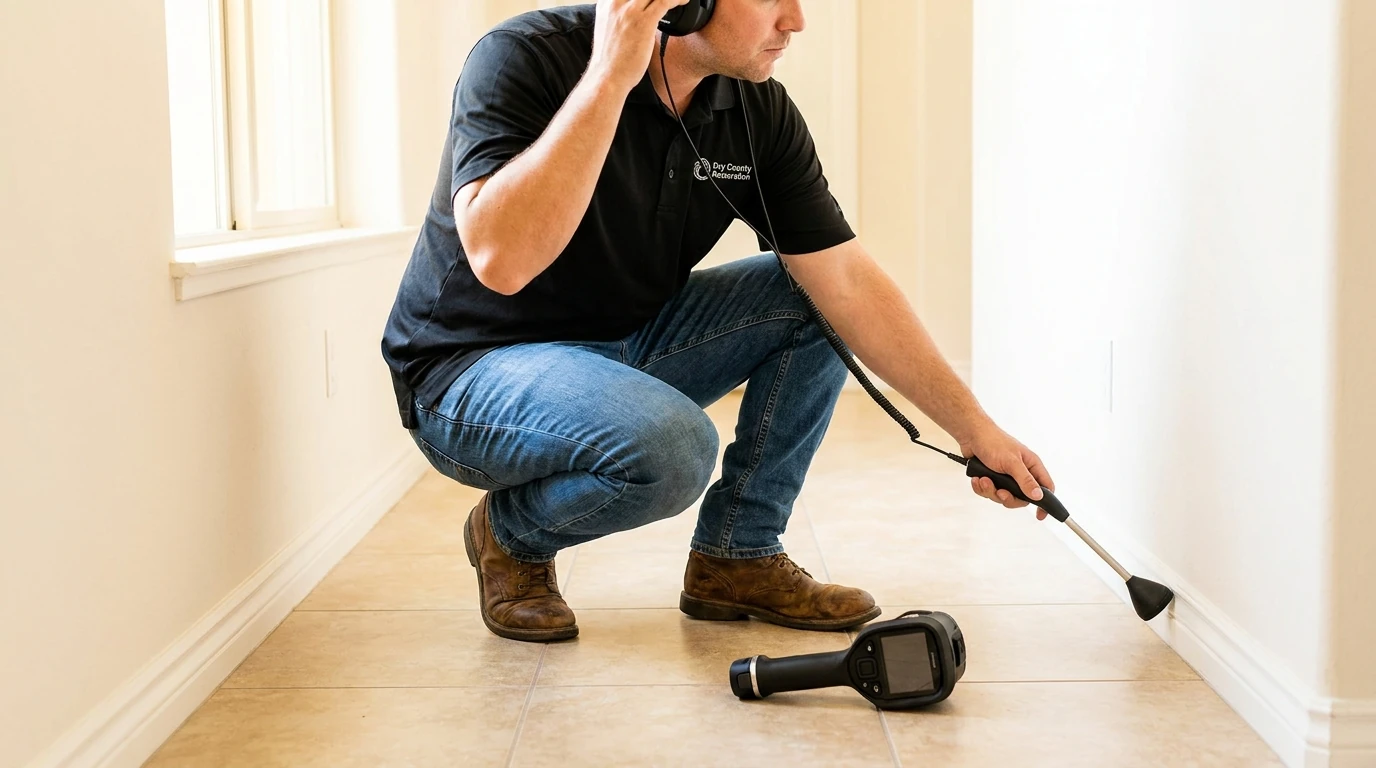
Acoustic detection equipment picks up the distinct sound of pressurized water escaping a pipe, a sound the human ear can’t isolate through drywall or concrete. The technician moves a sensor along the suspected pipe run and listens through headphones for the leak’s signature, then narrows the location by comparing volume at different points. This is the primary method for slab leaks, since the pipe is typically 4 to 6 inches under a concrete floor.
Thermal imaging cameras read surface temperature differences. A leak under flooring or inside a wall cools (or sometimes warms, on a hot water line) the surrounding material just enough to show up as a distinct patch on the camera. It won’t find every leak, since drywall and insulation can mask the temperature shift, but it’s fast and non-invasive, so it’s almost always the first pass. Moisture meters (pin or pinless) then confirm elevated moisture content in the suspected material, giving the crew a measured reading rather than a guess.
What Does a Leak Detection Inspection Actually Involve?
A leak detection inspection is a structured, 1-to-3-hour process that starts with a pressure test and ends with a marked, documented leak location. It does not involve opening walls unless the technician needs to confirm a reading.
- Isolate the system. The technician shuts off fixtures and appliances, then checks the water meter. If it’s still spinning with everything off, there’s an active leak somewhere in the supply line.
- Pressure test the line. A gauge connected to a hose bib or supply valve holds pressure and watches for drop-off, which confirms a leak exists before anyone starts hunting for it.
- Acoustic and thermal scan. The technician walks the suspected pipe run with listening equipment and a thermal camera, narrowing the search area to a few square feet.
- Moisture confirmation. A moisture meter checks the narrowed area against dry baseline readings elsewhere in the home.
- Documentation. The technician marks the exact location, photographs the readings, and writes up findings, which becomes the scope of work for the repair and the paperwork an insurance adjuster will want to see.
For a slab leak in an older Anaheim neighborhood near Angel Stadium where copper pipe runs under the foundation, this process usually confirms the leak’s location without a single test cut. For a wall leak behind a shower valve, the technician may need one small inspection hole to visually confirm what the instruments are reading.
What Are the Warning Signs You Need Leak Detection, Not Just a Plumber Visit?
You need leak detection specifically (not a general plumbing call) when the leak’s location isn’t visible but the symptoms are clear. A plumber fixes a leak they can see. A leak detection inspection finds the one they can’t.
Watch for these signs: a water bill that jumps without a change in usage, a warm spot on the floor (often a hot water line leak under a slab), the sound of running water with every fixture confirmed off, a musty smell with no visible moisture source, or a baseboard that’s warped despite dry-looking walls. According to the EPA’s WaterSense program, household leaks nationwide waste billions of gallons of water a year, and a single leak can run for months before producing a visible stain, since drywall and flooring absorb moisture long before they show it.
If you’ve already had a burst pipe and the visible repair is done but the bill still looks off, that’s also a leak detection call. A burst pipe repair fixes the point of failure a plumber found; it doesn’t rule out a second slow leak elsewhere in the line.
What Happens After a Leak Is Found?
Once a leak is located and documented, the next step is targeted access and repair, followed by moisture mitigation if the leak has already wetted any building material. The inspection report becomes the scope of work, so the repair crew opens exactly the drywall or slab section needed, not the whole wall.
If the leak has been running long enough to wet subfloor, insulation, or framing, drying that material to the IICRC S500 standard comes before any rebuild, otherwise trapped moisture becomes a mold problem inside the new wall. This is where a leak detection call and a water damage restoration job connect: the detection finds it, the mitigation dries it, and the repair closes it back up. If you’re not sure whether your situation needs just a repair or a full drying protocol, a written moisture assessment settles that before any demolition starts.
Dry County Restoration runs leak detection as a first step on water damage and burst pipe calls across Corona, Anaheim, and the surrounding Inland Empire and Orange County service area, and documents every reading for the insurance file.
About Dry County Restoration
Dry County Restoration is an IICRC Certified Firm (WRT, ASD, AMRT) licensed and insured (CA license #1083555), founded in 2020 and based in Corona, CA. The company operates 24/7 and serves Corona, Riverside, Anaheim, Santa Ana, and surrounding Inland Empire and Orange County communities with water damage restoration, water leak detection, burst pipe repair, mold remediation, fire and smoke restoration, and reconstruction services.