TL;DR: Renters insurance typically covers your personal belongings when a sudden, accidental water event damages them. It does not cover the building structure, that is your landlord’s responsibility under their own policy. Gradual leaks, flooding, and sewage backups are usually excluded unless you added specific riders. Knowing which policy covers what before you file saves you from a denied claim and a delayed recovery.
You came home to water dripping from the ceiling, soaking your couch, your laptop, and the clothes in your closet. Now you’re wondering whether your renters policy will actually pay for any of it, or whether your landlord’s insurance handles it. The answer depends on what caused the water and whose property got damaged. This post draws that line clearly so you know exactly what to file, what to skip, and when to call a restoration crew.
What does renters insurance actually cover when water is involved?
Renters insurance covers your personal property, furniture, electronics, clothing, appliances you own, when a covered peril causes the damage. Most standard renters policies (HO-4 form) list sudden and accidental water discharge as a covered peril. That means if your upstairs neighbor’s washing machine hose bursts and water soaks your unit, your renters policy can reimburse you for your damaged belongings. The building itself, including walls, floors, and ceilings, is your landlord’s problem.
The Insurance Information Institute summarizes the standard HO-4 covered perils clearly: sudden and accidental discharge from a plumbing system is in; flood and earth movement are out. That distinction matters more than most renters realize until they are standing in a wet apartment.
Here is what renters policies typically pay for:
- Personal property replacement or repair. Furniture, electronics, clothing, and other belongings damaged by a covered water event. Your policy may pay actual cash value (ACV, meaning depreciated value) or replacement cost value (RCV) depending on what you purchased.
- Additional living expenses (ALE). If the water damage makes your unit uninhabitable, your policy can cover a hotel, temporary rental, and extra meal costs while repairs happen.
- Liability. If you accidentally cause water damage to a neighbor’s unit (say, you left a bathtub running), your liability coverage may protect you from their claim against you.
What water damage is NOT covered by renters insurance?
Most denied renters claims fall into one of four categories, and knowing them ahead of time protects you.
Flooding from outside. Standard renters policies exclude flood damage, water that enters from the ground up, storm surge, or overflowing rivers. If your first-floor apartment floods during a heavy rain event, your renters policy will not pay. Separate flood insurance through the National Flood Insurance Program (NFIP) or a private carrier is the only coverage for that scenario.
Gradual leaks and neglect. If a slow drip under your bathroom sink has been going for weeks and eventually warps your cabinet and flooring, that is considered a maintenance issue. Insurers call this “long-term seepage” and it is excluded from virtually every standard policy. The logic: you or your landlord should have caught it. Document any leaks you report to your landlord in writing, that paper trail matters if there is a dispute later.
Sewage backup and water backup. A sewer line backup or a drain that reverses is not the same thing as a burst pipe in most policy language. Many standard renters policies exclude water backup entirely. You can usually add a water backup rider for a modest annual premium, worth it if you are in a basement unit or an older building. If raw sewage entered your unit, that is a Category 3 water event, also called black water, and it requires professional sewage cleanup, not a DIY mop job.
Mold from a covered event. Some policies cover mold remediation if the mold resulted directly from a covered water event and you reported it promptly. Others cap mold coverage at a low limit or exclude it entirely. Read your declarations page carefully. If mold appears after a water loss, document it immediately and report it to your insurer before any remediation begins.
Your landlord’s property. The building structure, walls, flooring that is part of the unit, appliances the landlord owns, and common areas are covered under the landlord’s dwelling policy, not yours. If the ceiling caves in because of a roof leak, your landlord files the claim, not you. You file for your damaged belongings.
Does renters insurance cover a burst pipe?
Yes, in most cases. A burst pipe is the clearest example of a sudden, accidental water event, the exact scenario most renters policies are written to cover. If a pipe in your unit or in the building’s plumbing system bursts and damages your personal property, your renters policy should respond for your belongings. The landlord’s policy covers the structural damage to the unit itself.
If you are dealing with a burst pipe right now, the first steps matter: shut off the water source if you can access it, move belongings out of the water’s path, and document everything with photos and video before anything is moved or dried. A detailed record is the foundation of a successful claim. For a step-by-step response guide, see our burst pipe emergency checklist.
One important nuance: if the pipe burst because of deferred maintenance that you reported to your landlord and they ignored, you may have a subrogation claim, your insurer pays you, then pursues the landlord for reimbursement. Keep every written communication with your landlord about maintenance requests.
What about water damage from an upstairs neighbor?
This is one of the most common renters insurance questions, and the answer is: it depends on who caused it and whose property was damaged.
If your upstairs neighbor’s pipe bursts or their bathtub overflows and water comes through your ceiling and damages your belongings, your renters policy covers your personal property. You do not have to wait for your neighbor or their insurer to pay you, file with your own carrier first. Your insurer may then subrogate against your neighbor’s liability coverage.
If the damage was caused by building infrastructure (a shared pipe in the wall, a roof leak, a building-wide plumbing failure), that falls on the landlord’s policy. Your renters policy still covers your belongings, but the structural repair is the landlord’s claim.
Document the source of the water as specifically as you can. A photo of the water stain on your ceiling plus a text message from your neighbor confirming their pipe failed is far more useful than a verbal account three weeks later.
Is water damage covered by insurance in California? State-specific rules to know.
California renters follow the same basic HO-4 framework as the rest of the country, but there are a few state-specific things worth knowing.
The California Department of Insurance regulates how insurers handle claims in the state, including timelines: insurers must acknowledge a claim within 15 days and accept or deny it within 40 days of receiving proof of loss. If your insurer is dragging its feet, you can file a complaint directly with the CDI.
California does not require landlords to carry renter’s insurance on your behalf, and it does not mandate that renters carry it, but many landlords now require it as a lease condition. If your lease requires it and you let it lapse, you may be on the hook for damage out of pocket.
California’s high-density housing stock, apartment complexes, condos, multi-family buildings, means neighbor-caused water damage is especially common. Knowing your policy’s water backup and liability limits before something happens is the single most useful thing you can do.
Should you file a renters insurance claim for water damage?
Not every water event is worth a claim. Filing a claim can raise your premium at renewal, and if your deductible is high enough, a small loss may not clear it anyway.
File a claim when:
- Your personal property loss clearly exceeds your deductible
- You need additional living expenses coverage because the unit is uninhabitable
- A neighbor or third party caused the damage and liability is disputed
Skip the claim when:
- The loss is minor and close to your deductible
- You have had a recent claim and another could trigger non-renewal
- The damage is to the building structure only (not your property)
If you are unsure, call your insurer and ask hypothetically before officially filing. Most agents will walk you through the math without opening a claim.
For a deeper look at how homeowners policies handle water damage (useful if you own the unit or are comparing coverage types), see our post on does homeowners insurance cover water damage.
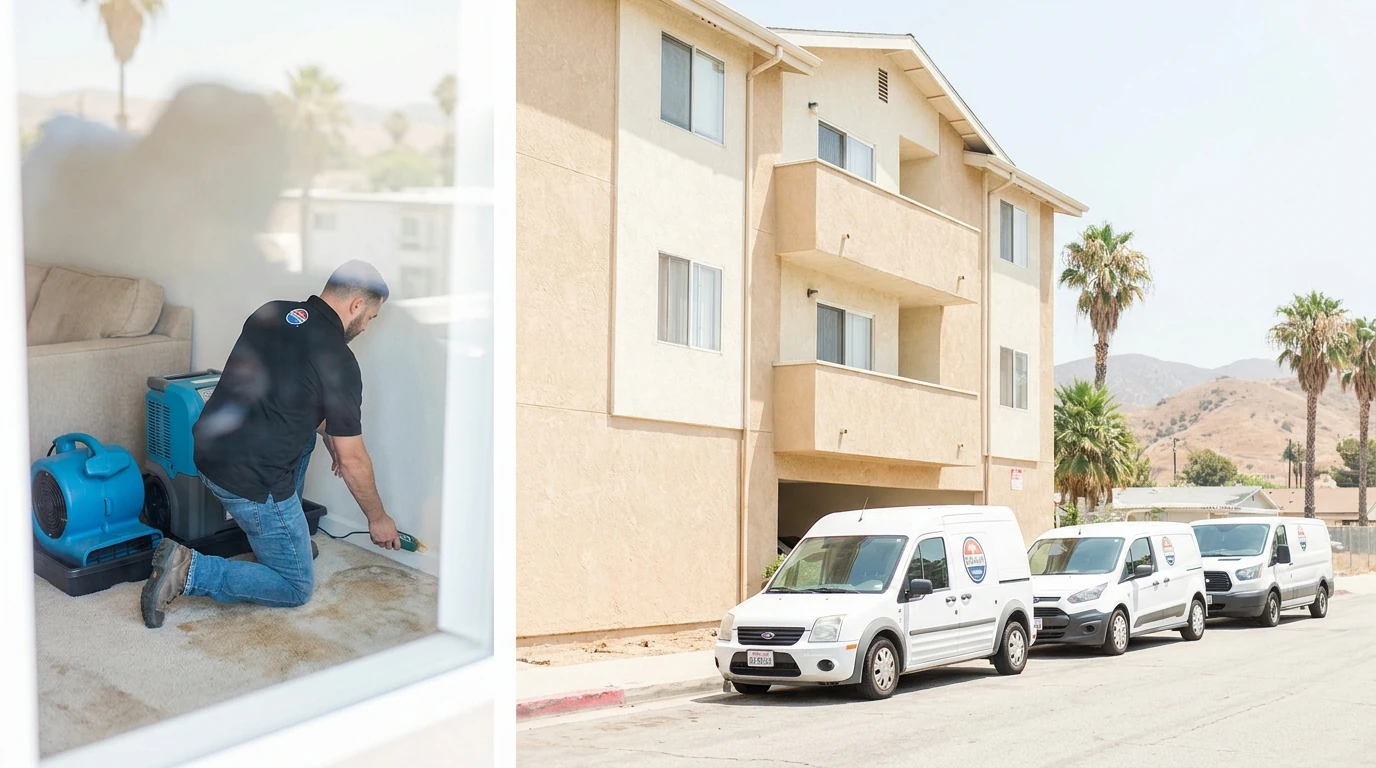
When water damage has already happened and you need professional drying and documentation, Dry County Restoration provides water damage restoration and sewage cleanup for renters and property owners across Corona, Riverside, Anaheim, and the surrounding Inland Empire. A written scope of work from a certified restoration crew is the documentation your insurer needs to process a contents claim accurately.
About Dry County Restoration
Dry County Restoration is an IICRC-certified firm serving Corona, CA and the surrounding Inland Empire since 2020 (CA License 1083555). Their IICRC-certified crews hold Water Restoration Technician (WRT), Applied Structural Drying (ASD), and Applied Microbial Remediation Technician (AMRT) credentials. Services include water damage restoration, sewage cleanup, mold remediation, fire damage restoration, storm damage restoration, and general contracting across Corona, Riverside, Anaheim, Santa Ana, Ontario, Fullerton, Norco, Chino, and Chino Hills. Dry County Restoration is licensed, insured, and locally owned.